
What’s New in Arcfra Enterprise Cloud Platform 6.3
Architecture-Level Enhancements for Availability, Performance, and Enterprise Resilience
In today’s environment — marked by rising VMware licensing costs, increasing vendor lock-in concerns, and growing architectural complexity — CIOs and infrastructure leaders are reassessing their cloud strategy through a different lens.
When evaluating a credible VMware alternative, the key concerns are far more strategic:
Modern infrastructure must simultaneously deliver:
- Enterprise-grade availability that protects mission-critical workloads without architectural workarounds
- Predictable, high-performance I/O and networking for databases, AI/ML, and latency-sensitive applications
- Integrated business continuity capabilities without bolted-on third-party tooling
- Security and compliance by design, covering encryption in transit and at rest
- Operational simplicity at scale, reducing dependency on highly specialized expertise
- Economic sustainability, avoiding escalating licensing costs and rigid commercial models
- Architectural flexibility, enabling active-active, multi-site, and hybrid-ready designs
In short, the discussion is no longer about replacing a hypervisor.
It is about selecting a platform that can deliver performance, resilience, security, and cost predictability — without recreating the operational complexity enterprises are trying to escape.
With Arcfra Enterprise Cloud Platform’s newest foundation — ACOS 6.3, Arcfra introduces architectural enhancements across compute, storage, and networking that directly address these enterprise requirements — while strengthening its position as a technically credible alternative to traditional VMware-centric stacks.
This blog provides a technical breakdown of the new release.
1. Availability Engineering: Beyond Basic HA
HA Support for Performance-Accelerated Workloads
A key architectural enhancement is HA support for VMs equipped with:
- SR-IOV passthrough NICs
- vGPUs
Historically, passthrough devices limited mobility and HA flexibility. ACOS 6.3.0 closes that gap, allowing performance-optimized workloads to remain within the HA protection domain — critical for AI/VDI nodes, low-latency trading systems, and network-intensive applications.
Event-Driven VM HA with Configurable Recovery Logic
ACOS 6.3 enhances VM High Availability with:
- Automated alerts triggered by HA success or failure events
- Configurable recovery actions for VM network failures:
I. Hot migration for transient disruptions
II. VM reconstruction for persistent faults
This introduces policy-driven recovery behavior rather than static failover logic. Infrastructure teams can align failure handling with workload criticality and failure domain characteristics.
More Affordable Active-Active Solution
ACOS 6.3 strengthens multi-site resilience through:
- Availability zone–level placement group policies.
- Reduced minimum configuration of stretch cluster: reduced to 4 nodes from the previous 6 nodes.
By lowering the infrastructure threshold, active-active architectures become achievable for mid-sized enterprises — not just large-scale deployments.
2. Performance Optimization Built into the Architecture
Default 8-Stripe Virtual Volumes
Virtual volumes now default to 8 stripes, increasing storage parallelism across distributed disks.
Impact:
- Higher concurrent I/O streams
- Improved disk-level workload distribution
- Better scaling under high VM density
This eliminates the need for manual stripe reconfiguration during performance tuning.
Boost Mode Enabled from Day 0
Boost mode is now enabled automatically during cluster installation.
This ensures:
- Optimized storage scheduling from deployment
- Reduced pre-production benchmarking cycles
- Predictable performance baseline across clusters
Performance is no longer an optional configuration — it is the default operating mode.
Modernized I/O Stack with IO_uring
ACOS 6.3 enables IO_uring by default, significantly improving asynchronous I/O efficiency.
Technical advantages include:
- Reduced syscall overhead
- Lower latency under high concurrency
- Improved CPU efficiency
This directly enhances random I/O scalability in transactional environments.
Multi-Channel Bandwidth Aggregation
The platform now fully utilizes Multi-Data Channel link aggregation, allowing multiple NICs to operate as a unified high-throughput pipeline.
This delivers:
- Higher sustained throughput
- Better network resource utilization
- Reduced bandwidth bottlenecks under mixed workloads
Intel DSA Hardware Acceleration
With Intel Data Streaming Accelerator (DSA) support, data movement tasks are offloaded from CPU cores to dedicated hardware engines.
Benefits include:
- Lower CPU contention
- Improved storage efficiency
- Higher stability during peak operations
RDMA Flexibility with Multi-Port Bonding
ACOS 6.3 supports:
- Online RDMA enable/disable
- Multi-port bonding across NICs within the virtual distributed switch
This allows administrators to dynamically scale storage bandwidth and reduce latency while maintaining deployment flexibility.
Eliminating Single-Node Bottlenecks
Additional enhancements include:
- Configurable virtual NIC queue counts for higher packet processing parallelism
- Multiple physical disk pools per node, each mapped to independent Chunk instances
These improvements ensure storage and network scaling keep pace with increasing VM density.
Validated Performance Results
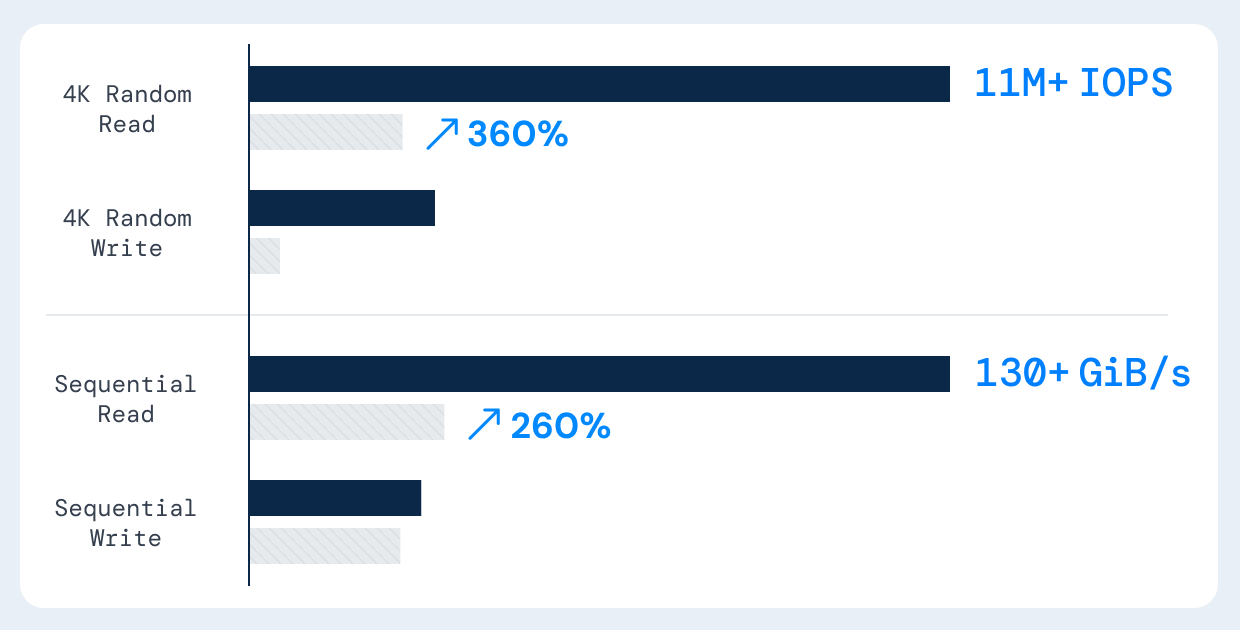
After implementing these architectural enhancements, ACOS 6.3 demonstrates substantial measurable improvements in a 3-node Intel-based cluster environment.
- 11 Million+ IOPS (4K Random Read) — 4.6x higher
- 130+ GiB/s (Sequential Read) — 3.6x higher
- <100 μs latency in 4K Random Read
Performance Disclaimer
Performance data is based on internal testing with specific hardware configurations (Intel platform, 3-node Arcfra cluster, ACOS 6.3 + 4 Instances); actual results may vary depending on system environment, workloads, and hardware specifications. Performance gains are calculated against the version 6.2 baseline. This configuration represents the maximum performance tier observed in the test. Please note that +4 Instances will result in higher CPU and memory consumption. This trade-off is necessary to achieve peak I/O density and throughput. Optimal performance is subject to system environment conditions and overall cluster health.
3. Disaster Recovery: Zero RPO with Synchronous Replication
Through integration with Arcfra Backup & Disaster Recovery, ACOS 6.3 introduces synchronous VM-level replication.
Key Characteristics:
- Real-time data consistency
- RPO = 0
- VM as the protected entity
From an architectural standpoint, this simplifies disaster recovery design:
- No need for external array-based replication
- Reduced dependency on third-party tooling
- Consistent protection semantics at the virtualization layer
For financial services, healthcare, and manufacturing workloads, this delivers continuous data protection without layered integration complexity.
4. Security Hardening Across Layers
Security improvements in 6.3 address data in transit, at rest, and network visibility.
Encrypted Live Migration
Clusters can enable encryption for hot migration, ensuring:
- Confidentiality of memory and disk state during VM movement
- Alignment with regulatory data-in-transit requirements
Encryption at Rest with Integrated KMS
Volume data encryption is supported using a built-in key management service.
Technical benefits:
- Simplified key lifecycle management
- Reduced integration overhead
- Lower operational complexity compared to external KMS solutions
Network Visibility and Control
ACOS 6.3 enhances network-layer security through:
- Traffic mirroring via ERSPAN tunnels for external analysis systems
- IGMP/MLD snooping support on the virtual distributed switch
These features improve multicast efficiency and provide enhanced monitoring capabilities for compliance and threat detection frameworks.
Cluster-Wide Security Baseline Enforcement
Administrators can now:
- Modify SSH service ports uniformly across all hosts in a cluster
This enables rapid security baseline standardization across large environments.
5. Operational Efficiency and Lifecycle Management
Operational friction often drives hidden infrastructure costs. ACOS 6.3 introduces multiple lifecycle improvements.
Batch VMTools Upgrade
Multiple VMs can be selected and upgraded in a single action, significantly reducing repetitive maintenance tasks in large-scale environments.
Migration Reliability Improvements
Cross-cluster cold migration, staged migration, and cloning now preserve:
- Virtual NIC PCI addresses
This prevents post-migration network configuration failures and application binding issues.
Optimized Hot Migration in Non-Boost Mode
During cross-cluster hot migration in non-Boost mode, only valid data is transferred.
This reduces:
- Migration duration
- Bandwidth consumption
- Service disruption windows
ACOS 6.3 is More Than A Strong VMware Alternative
From a technical standpoint, ACOS 6.3 demonstrates maturity across:
- Distributed storage performance engineering
- Policy-driven HA orchestration
- Integrated synchronous replication
- RDMA-enabled high-performance networking
- Built-in security controls
For organizations reassessing virtualization platforms, the differentiators are clear:
- Performance optimization is embedded by default
- Active-active architecture is economically accessible
- RPO = 0 replication is integrated at the virtualization layer
- Operational complexity is reduced through automation and batch controls
Rather than layering performance tuning, DR tooling, and security add-ons on top of a hypervisor, ACOS 6.3 integrates these capabilities into a unified platform.
Conclusion
ACOS 6.3 represents a deliberate architectural evolution:
- Availability engineered for real-world failure domains
- Storage and network acceleration optimized at the system level
- Enhanced disaster recovery with synchronous replication
- Security controls aligned with enterprise compliance
- Operational simplification for large-scale clusters
For IT decision makers and cloud professionals seeking a technically robust, cost-conscious alternative to traditional VMware environments, ACOS 6.3 provides a compelling foundation for next-generation cloud and AI infrastructure.
Arcfra simplifies enterprise cloud infrastructure with a full-stack, software-defined platform built for the AI era. We deliver computing, storage, networking, security, Kubernetes, and more — all in one streamlined solution. Supporting VMs, containers, and AI workloads, Arcfra offers future-proof infrastructure trusted by enterprises across e-commerce, finance, and manufacturing. Arcfra is recognized by Gartner as a Representative Vendor in full-stack hyperconverged infrastructure. Learn more at www.arcfra.com.