

Arcfra Releases AECP 7.0 with AECP Compute Edition, Extending VMware Migration to Existing SANs
Replace VMware. Run Private AI. One Platform.
AECP Compute Edition lets enterprises replace VMware while retaining existing FC and iSCSI SANs. AECP 7.0 raises VM density with per-VM memory overcommit, adds per-VM Boost, and strengthens host and guest security with VM Secure Boot and vTPM, helping customers get more production capacity from existing hardware.
Arcfra today released the Arcfra Enterprise Cloud Platform (AECP) 7.0 with AECP Compute Edition. The release lets customers replace the virtualization layer while retaining their existing arrays, fabrics, and storage runbooks. It raises VM density with per-VM memory overcommit and per-VM Boost, strengthens security from host to guest, adds Layer 7 load balancing, and simplifies day-2 operations. These improvements run within the same AECP platform customers use for VDI, data protection, network services, and on-premises AI, keeping operations under one management model.
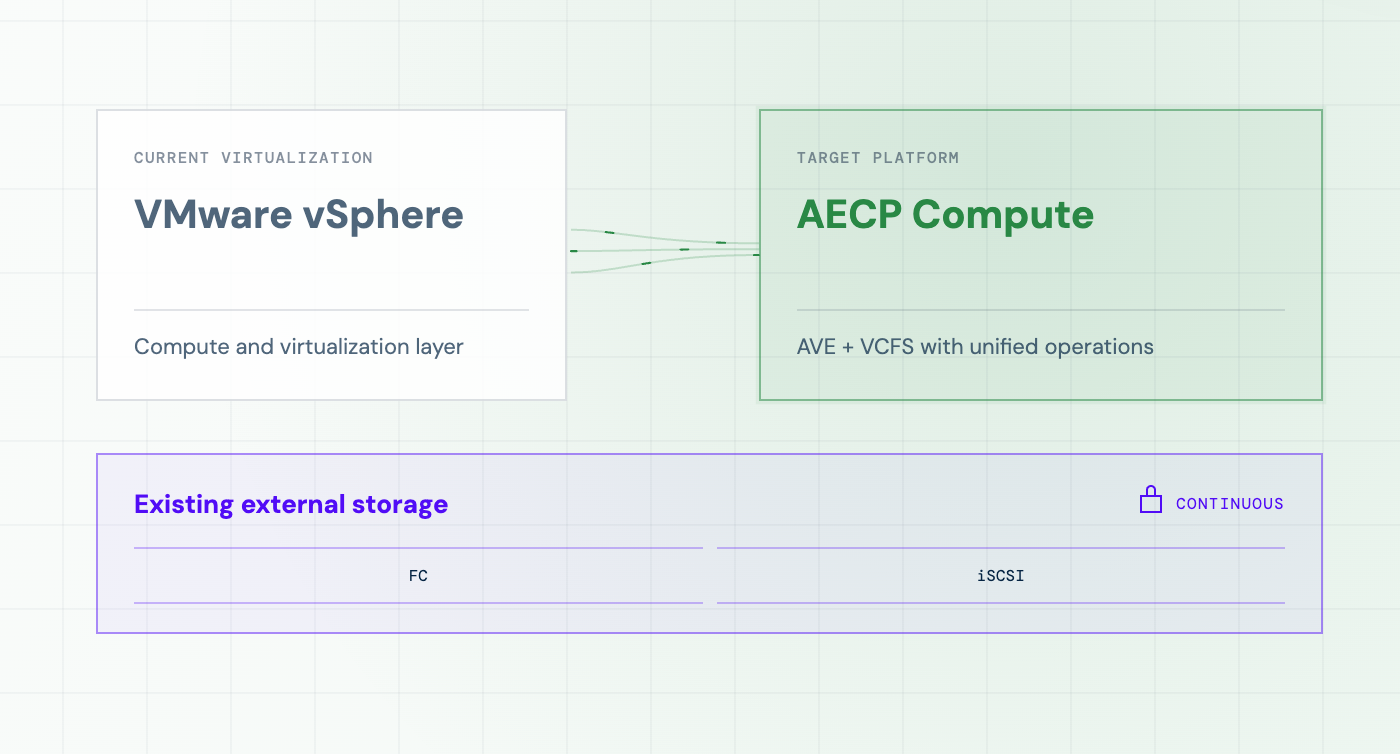
Figure 1. AECP Compute replaces the vSphere compute layer while existing FC and iSCSI SANs remain connected. Source: Arcfra.
Keep the array and replace only the hypervisor
AECP Compute Edition treats the hypervisor and storage as separate infrastructure decisions. At its core is Arcfra-developed VCFS (Virtualization Cluster File System), designed to turn existing FC and iSCSI SAN LUNs into VM-native shared datastores. Customers facing a VMware renewal can start with compute while retaining their existing operating model.
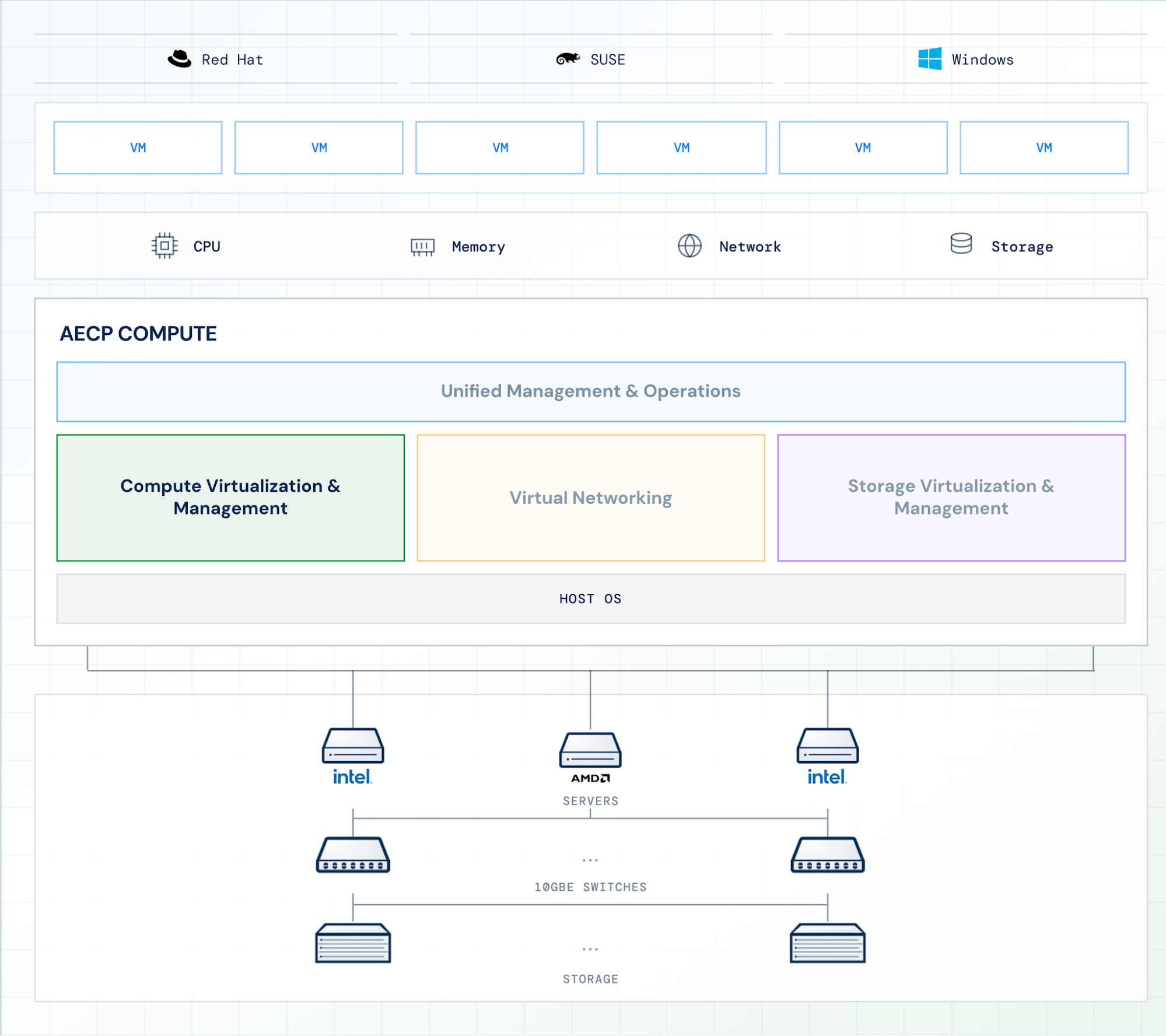
Figure 2. AECP Compute combines AVE, AOC, virtual networking, and VCFS across existing servers and storage. Source: Arcfra.
- Keep the storage architecture and operating model. VCFS exposes FC and iSCSI SAN LUNs as shared datastores, stores VM disks as files, and follows a VMFS-like operating model. Snapshots, clones, space reclaim, etc. are native to the filesystem.
- Keep arrays flexible. One AECP cluster can use multiple LUNs from several arrays and move running VMs’ disks between them with live storage migration.
- Reclaim every host for workloads. VCFS needs no controller VM, so host CPU and memory stay with the VMs.
- Reduce dependence on heartbeat networks. VCFS uses shared-disk locks and heartbeats, limiting the risk that a network failure isolates a host or disrupts workloads.
- Provide a direct I/O path for VMs. Through vHost, VMs connect to the local primary VCFS service and reach shared LUNs over a dedicated storage path, avoiding the extra layers of a general-purpose open-source filesystem stack to improve I/O efficiency and stability.
- Upgrade with less disruption. VCFS runs control and monitoring services in user space, decoupling them from the kernel and reducing the effect of upgrades on running workloads.
- Scale compute and storage on separate schedules. A single VCFS datastore supports up to 64 hosts and 4,096 VMs, while Arcfra Operation Center (AOC) 4.10 manages external-storage and hyperconverged infrastructure (HCI) clusters from one console.
Use existing servers for more work and strengthen security from host to guest
AECP 7.0 addresses two recurring infrastructure pressures: server capacity and security across the host and guest.
- Raise VM density with business-aware controls. Per-VM memory overcommit reserves configured memory for critical applications and allocates physical memory to overcommitted VMs based on actual active use.
- Control contention without sacrificing swap protection. Each overcommitted VM gets dedicated swap space: a replicated volume on HCI clusters, or a swap file on the VCFS datastore, created, expanded, and removed with the VM.
- Keep overcommitted VMs manageable. VMs using memory overcommit remain eligible for live migration, distributed resource scheduling (DRS), and high availability workflows.
- Focus acceleration on the workloads that need it. Administrators can enable Boost I/O acceleration for individual VMs, sending CPU overhead to high-I/O workloads.
- Establish trust at the host layer. Host Secure Boot, software integrity verification, and host hardening help prevent compromised platform software from entering the boot chain.
- Meet Windows 11 and encryption requirements. VM Secure Boot and virtual Trusted Platform Modules support Windows 11, BitLocker, and Credential Guard on both external-storage and HCI deployments.
- Lock down hosts by default. The host firewall is on by default for new clusters, with cluster-service rules maintained automatically and IP allowlists for management access.
Replace vSphere without changing operating model
Customers can manage external-storage and HCI clusters through one control plane and retain a familiar operating process.
- Use one console across deployment models. AOC 4.10 manages AECP Compute Edition and HCI clusters and can run on external VCFS storage. Key areas of the interface are available in Japanese.
- Reduce lifecycle change risk. Administrators can take clusters online or offline through the graphical interface, while VMTools upgrades independently of the platform.
- Deliver external-storage resources faster. AOC adds acceleration for resource distribution and migration in external-storage environments.
- See capacity and network issues sooner. Capacity forecasting helps teams plan resources, while storage network routing, VLAN and trunk support, and traffic visualization support day-2 troubleshooting. Read more: Network Topology Visualization in Arcfra AECP.
- Migrate VMware workloads to AECP Compute clusters. Arcfra plans to add Migration Tool 2.1 to support AECP Compute Edition clusters as a target for agentless warm migration from ESXi 5.0–8.0 and vCenter 6.0–8.0.

Figure 3. AECP Compute supports a lower-risk migration path through existing storage, agentless VM migration, and predictable TCO. Source: Arcfra.
Support application traffic without another appliance
ANS 3.6 adds request-level load balancing to the connection-level capabilities customers already use.
- Balance application and connection traffic on one platform. Arcfra Network Service (ANS) uses Layer 7 load balancing for request-level distribution and existing Layer 4 functions for connection-level traffic. Customers can avoid a separate load-balancing product for those workloads.
Modernize VDI without changing Horizon workflows
AECP Virtual Desktop Infrastructure (VDI) Standard combines compute and storage in an Omnissa-certified stack, so customers can replace vSphere and vSAN without changing Horizon workflows.
- Keep a certified, supported stack. The Arcfra Virtualization Engine (AVE) and Arcfra Block Storage (ABS) are each Omnissa-certified for Horizon.
- Avoid storage true-ups as the desktop estate grows. Arcfra licenses the edition by CPU core without a storage capacity charge.
- Improve VDI user experience without performance storms. Data locality keeps read I/O on the local host, reducing network pressure during boot and login peaks.
- Lower cloud infrastructure software cost. In a 500-seat office-worker reference architecture, Arcfra estimates that AECP VDI Standard can reduce cloud infrastructure software costs by up to 67% compared with Broadcom VMware in HCI mode.
Read more: Modernize the Infrastructure Under Omnissa Horizon, Now Fully Certified.
Keep existing backup software and retention policies
Customers can leave backup products, repositories, and retention policies in place when they migrate.
- Keep existing backup workflows. Commvault and Veeam protect AECP workloads through the Arcfra Data Protection Adapter (DPA) in agentless mode. NetBackup connects through Arcfra Backup and Disaster Recovery (ABDR) in agentless mode as well.
- Match support to the migration timeline. Converged deployments support Commvault and Veeam through DPA today, with NetBackup support through ABDR 2.4. Compute Edition will add NetBackup support through ABDR 2.5, followed by Commvault and Veeam support through DPA 1.1 with AECP 7.0 U1.
Add agentic AI without a separate infrastructure stack
AI teams can standardize model access on the same AECP infrastructure they use for enterprise VMs. Neutree is Arcfra’s on-premises Model-as-a-Service layer for agentic AI.
- Plan for shared model governance as agent use grows. Arcfra plans to enhance Neutree with capabilities such as OpenID Connect (OIDC) and Active Directory multi-tenancy, end-to-end observability, KV-cache offloading, and high availability enhancements.
Read more: From Fragmented Model Deployment to Unified Governance.
Notes on Product GA
AECP 7.0 with AECP Compute Edition is currently generally available. AECP VDI Standard launches with AECP 7.0 in HCI mode. Arcfra Migration Tool 2.1 is planned for November 2026.
At GA, converged deployments support Commvault and Veeam through DPA and NetBackup through ABDR 2.4. On Compute Edition, Arcfra plans NetBackup support through ABDR 2.5 in November, 2026, and Commvault and Veeam support through DPA 1.1 in December, 2026, with AECP 7.0 U1.
Read more: AECP 7.0: Elevating One Platform Beyond VMware, Ready for Cloud and AI
Arcfra simplifies enterprise cloud infrastructure with a full-stack, software-defined platform built for the AI era. We deliver computing, storage, networking, security, Kubernetes, and more — all in one streamlined solution. Supporting VMs, containers, and AI workloads, Arcfra offers future-proof infrastructure trusted by enterprises across e-commerce, finance, and manufacturing. Arcfra is recognized by Gartner as a Representative Vendor in full-stack hyperconverged infrastructure. Learn more at www.arcfra.com.