
Arcfra Kubernetes Engine 1.6: Enhancing Production Kubernetes with Form-Based Visual Management and Multi-Network Support
Today, Arcfra announces the release of Arcfra Kubernetes Engine (AKE) version 1.6, the latest version of its production-grade container management and service platform.
This release focuses on improving Kubernetes operational efficiency and strengthening production network management. AKE 1.6 introduces form-based visual management for Kubernetes resources, enabling users to deploy and manage applications without writing complex YAML files. It also adds support for separating workload cluster management networks from service networks and configuring multiple network interfaces for Pods, helping enterprises meet demanding requirements for security isolation, compliance, and high-performance networking.
Why This Release Matters
As Kubernetes adoption expands from infrastructure teams to application teams, enterprises need a simpler and more unified way to manage containerized workloads. Infrastructure and container O&M teams are responsible for cluster lifecycle and platform reliability, while application O&M and development teams focus on deploying and operating business applications. Although these teams work at different resource layers, they all need a consistent visual management experience to reduce collaboration costs, shorten the learning curve, and accelerate application rollout.
At the same time, customers in finance, healthcare, government, and large enterprise environments are placing higher demands on IT infrastructure autonomy, security, compliance, and network control. In many production scenarios, management traffic and service traffic must be strictly isolated. Business applications also need secure access to external systems such as databases, middleware, monitoring targets, and other enterprise services through independent service networks.
AKE 1.6 directly addresses these operational and networking challenges. By extending visual management from cluster infrastructure to Kubernetes application resources, and by enhancing network isolation and multi-network access capabilities, AKE 1.6 helps enterprises operate Kubernetes more efficiently and securely in complex production environments.
Key Innovations in AKE 1.6
1. Form-Based Visual Management for Kubernetes Resources
AKE 1.6 introduces form-based deployment and management for Kubernetes resources, allowing users to complete common application operations through the UI instead of manually writing and maintaining YAML files.
This capability brings infrastructure, Kubernetes clusters, and business applications into a more unified visual management experience. Users can view related resources in a single interface, access frequent operations more directly, and reduce the operational complexity of managing containerized applications.
Key advantages include:
- Fewer interface switches: Related Kubernetes resources are aggregated in a unified view, reducing the need to move across multiple pages and improving troubleshooting and change efficiency.
- Faster operations: Quick entries are added for frequent operations, shortening operation paths and helping O&M teams complete routine changes more directly.
- Faster application rollout: Integration with container image registry permissions allows users to select and use images directly without repeated credential configuration, improving both efficiency and security.
- Faster troubleshooting: End-to-end PVC → PV → Volume topology visibility helps users trace storage relationships from containers to infrastructure and quickly locate storage-related issues.
With these improvements, AKE 1.6 lowers the barrier to Kubernetes operations and makes application delivery more accessible to teams that are newly adopting containers or managing production application rollout.
2. Separated Management and Service Networks for Workload Clusters
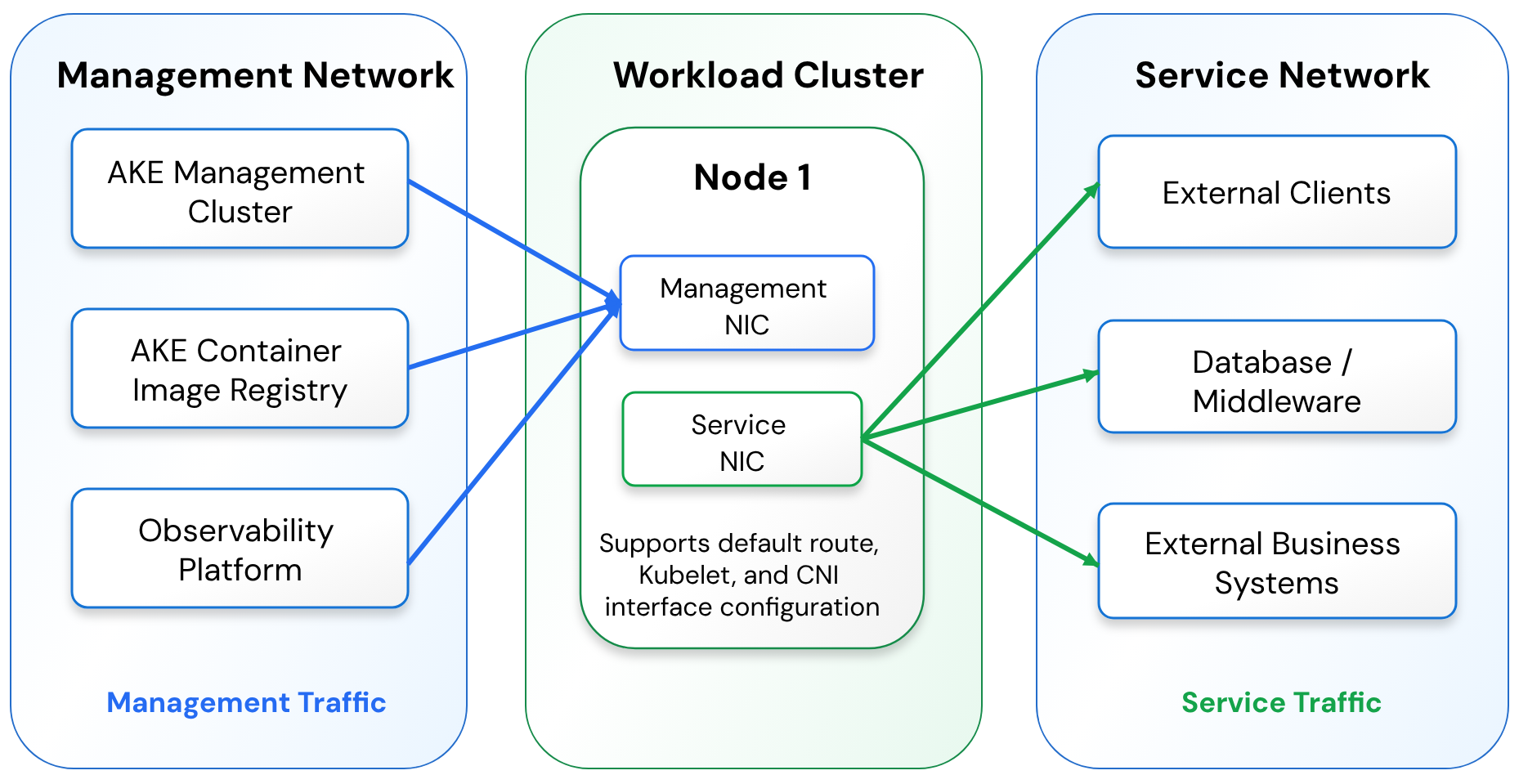
To prevent management traffic and service traffic from affecting each other, AKE 1.6 supports separating the management network from the service network for workload clusters.
In this architecture, management traffic and business service traffic are isolated into separate network planes. The container service network cannot directly route to control plane components such as the Kubernetes apiserver. Even if a container is compromised, control plane operations remain isolated and unaffected, improving platform security and helping enterprises meet network isolation and compliance requirements.
This capability is especially valuable for customers in finance, government, healthcare, and large enterprise environments where security domains must be clearly separated.
Main capabilities include:
- Configuring management NICs and service NICs for workload clusters to separate management and service traffic.
- Configuring the default route egress, static routes, Kubelet Node IP, and CNI primary interface during cluster creation.
- Adding service NICs after cluster creation and maintaining static routing rules.
- Providing graphical configuration entries to reduce deployment and O&M complexity in complex network environments.
3. Multiple Pod NICs for High-Performance and Isolated Network Access
AKE 1.6 also introduces support for configuring multiple network interfaces for Pods. This capability is designed for scenarios where applications need to access multiple network planes for security isolation, direct connectivity, or higher network performance.
After the feature is enabled, the system automatically configures dedicated Pod NICs for each node. Containers can then access flat networks through additional NICs, enabling direct communication with external application systems while keeping traffic isolated from other network planes.
.png)
Compared with Overlay networking, direct flat network access can reduce network overhead and deliver higher throughput and lower latency, with an approximately 20% performance improvement in applicable scenarios. It also allows specific Pods to connect precisely to designated dedicated networks, giving enterprises more flexible and controllable application networking.
This capability is particularly suitable for high-performance applications, multi-network business systems, and production environments with strict service network isolation requirements.
AKE: Proven in Production
AKE continues to power mission-critical systems, helping enterprises in finance, healthcare, manufacturing, e-commerce, and other sectors build converged virtualization and container infrastructure:
- ConnectWave, a leader in South Korea’s e-commerce market, uses AKE to run its PLAi AI platform, gaining the performance and flexibility required for efficient model training and deployment.
- An EMS leader implemented AKE to unify management of container workloads across DevTest and Shop Floor Control systems, increasing operational efficiency and service quality.
Learn More
Arcfra simplifies enterprise cloud infrastructure with a full-stack, software-defined platform built for the AI era. We deliver computing, storage, networking, security, Kubernetes, and more — all in one streamlined solution. Supporting VMs, containers, and AI workloads, Arcfra offers future-proof infrastructure trusted by enterprises across e-commerce, finance, and manufacturing. Arcfra is recognized by Gartner as a Representative Vendor in full-stack hyperconverged infrastructure. Learn more at www.arcfra.com.