
Why VMware Replacement Cannot Be Simply Treated as a Hypervisor Swap?
Key Takeaway
VMware Cloud Foundation (VCF) is not a single product or a single virtualization layer. It is an integrated stack spanning compute, storage, networking, Kubernetes, disaster recovery, and operations management. Replacing only vSphere may reduce one license line item, but it leaves a dependency vacuum across the rest of the infrastructure. For enterprise environments, the real decision is whether the replacement platform can match both the breadth of VMware’s functional coverage and the depth required to run production workloads at scale.
Why VMware Replacement Cannot Be Simply Treated as a Hypervisor Swap
Broadcom’s 2023 acquisition of VMware triggered license increases of 3–10x for most enterprise customers and the end of perpetual licensing. The resulting urgency to find alternatives has led many IT teams to make a critical mistake: treating VMware replacement as a hypervisor-swap problem, when it is actually a platform architecture decision.
VMware Cloud Foundation (VCF) was never a single product. It was an integrated stack: vSphere, vSAN, NSX, Tanzu, SRM, and Aria (vRealize). Most enterprises have gradually built dependency on this stack over 10–15 years. Replacing one layer while leaving the rest either missing or sourced from disparate vendors recreates the fragmentation problem that VMware originally solved.
This is why replacing vSphere with a hypervisor-only alternative without considering the whole infrastructure creates a migration trap. It eliminates one line item but creates a dependency vacuum: storage, networking, disaster recovery, backup, Kubernetes, and management must each be re-sourced. The resulting multi-vendor environment is often more expensive and operationally more complex than the VMware stack it replaced.
A rigorous VMware alternative evaluation therefore needs to score every candidate platform on two independent axes.
- Platform breadth asks whether the platform covers every functional layer that the VMware stack covered. At minimum, this includes compute virtualization, software-defined storage, integrated Kubernetes, disaster recovery, software-defined networking, operations and management, migration, and ecosystem integration.
- Platform depth asks whether each capability actually meets enterprise-grade requirements. A platform may claim broad coverage, but still fail under production load if it lacks the required depth in high availability and resilience, performance, scalability, security, AI readiness, or hardware flexibility.
Platforms that pass the breadth test often fail the depth test, and those failures may surface 12–18 months after migration under real production workloads. For example, a platform with a Kubernetes gap cannot absorb containerized workloads in early migration waves, delaying the decommissioning of VMware Tanzu and extending the parallel licensing period. A platform with weak storage rebuild behavior may create availability risk when Tier-1 applications such as Oracle Database or SAP HANA are migrated onto it.
The key insight is that the real cost of a wrong platform decision is not the first-year license bill. It is the five-year re-architecture cost when the replacement fails to scale or requires additional point products to close capability gaps.
Download the Whitepaper for VMware Alternative Evaluation
For a complete Breadth-Depth (2x2) evaluation framework, six top vendor comparisons, and a 56-question evaluation checklist, download the white paper: Beyond the Hypervisor Swap: Why VMware Replacement Demands Both Platform Breadth and Depth.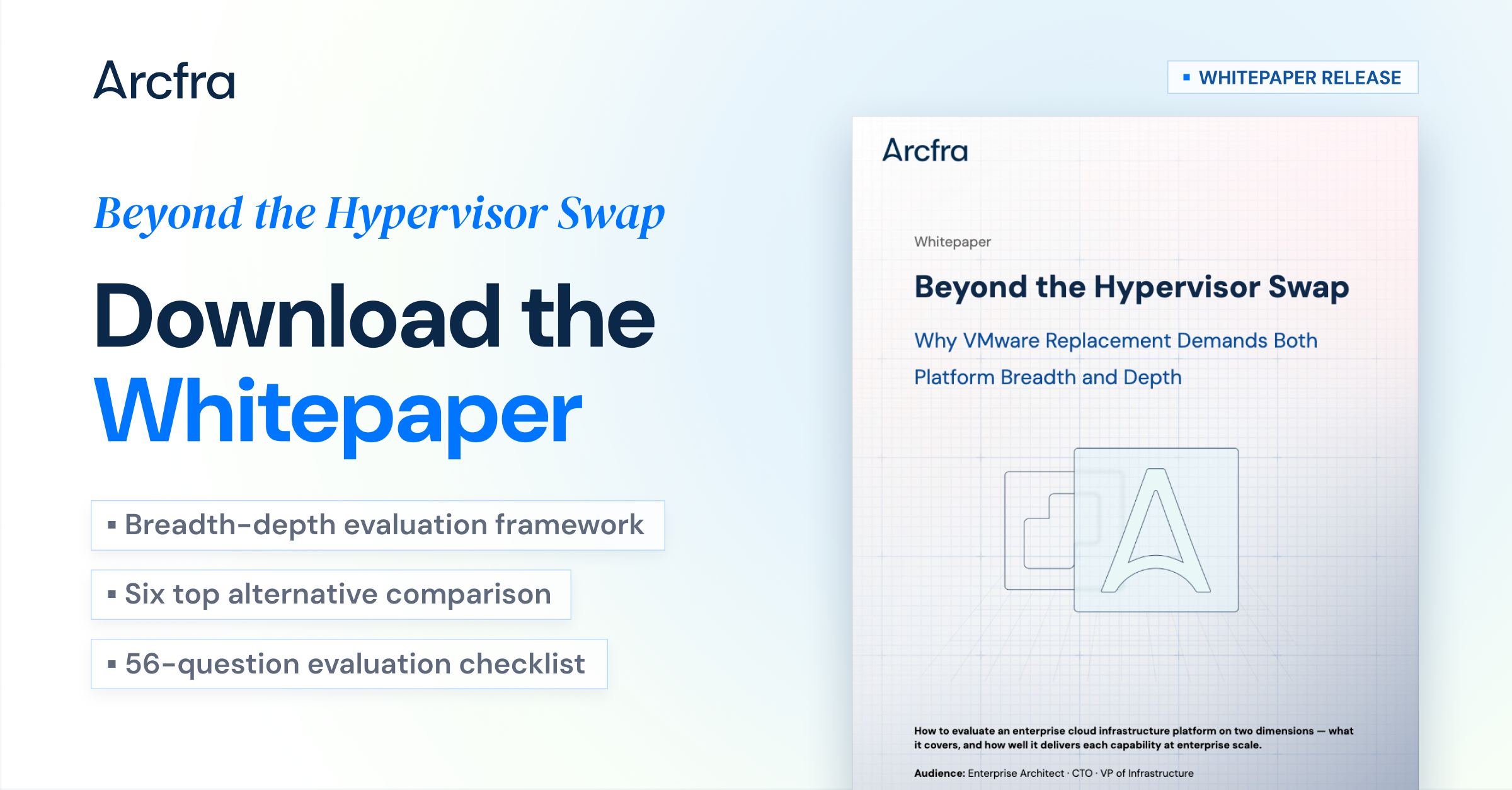
Arcfra simplifies enterprise cloud infrastructure with a full-stack, software-defined platform built for the AI era. We deliver computing, storage, networking, security, Kubernetes, and more — all in one streamlined solution. Supporting VMs, containers, and AI workloads, Arcfra offers future-proof infrastructure trusted by enterprises across e-commerce, finance, and manufacturing. Arcfra is recognized by Gartner as a Representative Vendor in full-stack hyperconverged infrastructure. Learn more at www.arcfra.com.