
How to Evaluate VMware Alternatives in 2026 | A 2x2 Framework
Key Takeaways
Enterprises should evaluate VMware alternatives as platform architecture decisions, not hypervisor swaps. The assessment should cover both platform breadth, meaning the functional layers VMware has provided across compute, storage, networking, Kubernetes, disaster recovery, management, migration, and ecosystem integration, and platform depth, meaning whether each claimed capability can meet enterprise requirements for reliability, performance, scalability, security, AI readiness, and hardware flexibility.
What Capabilities Should Enterprises Evaluate in a VMware Alternative?
Enterprises should evaluate VMware alternatives across two independent axes: platform breadth and platform depth. A strong score on one axis without the other is not sufficient for enterprise production.
Axis 1: Platform Breadth
Breadth asks: does this platform cover every functional layer that the VMware stack covers? Eight capability areas — spanning thirty-two testable criteria — constitute the minimum breadth checklist for a true VMware replacement:
- Compute Virtualization
Hypervisor + VM lifecycle management; live migration; VM placement control (affinity/anti-affinity groups); CPU/NUMA/SR-IOV/PCI passthrough support; VM encryption, secure boot, and TPM.
- Software-Defined Storage
Distributed block storage with RF2/RF3 replication and erasure coding; data localization (local replica on the VM host); no single-disk or single-controller bottleneck; storage data services (encryption, snapshots, clones) included natively.
- Integrated Kubernetes
Production-grade container orchestration native to the platform (not a separately deployed or cloud-delivered add-on); platform and K8s lifecycle managed together; GPU-schedulable; VM and container workload colocation on shared infrastructure; integrated stack with CSI, CNI and observability; DR for K8s cluster.
- Disaster Recovery (DR)
Aligns with the defined RPO/RTO for your applications and covers the full data protection spectrum: agentless and VM-consistent backup; async/sync replication to a secondary site with DR drill capability or cross-site active-active with automatic failover and zero data loss; automated failback, boot ordering, dependency mapping, and DR runbook orchestration.
- Software-Defined Networking (SDN)
Covers the full network and security stack: virtual switching, VLAN, and VxLAN routing; distributed firewall with workload-identity-based micro-segmentation; integrated load balancing for VM and container workloads; VPC-level tenant network isolation; all on-premises native, not cloud-delivered.
- Operation and Management (O&M)
A full-featured enterprise infrastructure management platform must deliver VM and cluster lifecycle management, performance monitoring and capacity planning, compliance enforcement, non-disruptive rolling upgrades across the full stack — including firmware, hypervisor, storage, networking, and Kubernetes — and unified observability across all layers from a single operational interface.
Two adjacent VMware capabilities are frequently raised but should not drive platform selection. Self-service automation (Aria/vRealize Automation) is a workflow layer above infrastructure management, not part of it. Native REST APIs and IaC tooling (Terraform, etc.) available on the evaluated platform provide a more portable foundation; Aria parity is an automation strategy decision, not a platform criterion. Multi-tenant virtual data center use cases (vCloud Director) are specific to service providers or enterprises running formal chargeback models. For most enterprise workloads, VPC-level network isolation in the SDN layer addresses the actual requirement — organizations should confirm whether the use case is genuine multi-tenancy or conventional workload isolation before treating vCD replacement as a hard requirement.
- Migration
Native, agentless V2V migration from VMware without requiring a third-party tool; source VMs remain online throughout the full data copy phase with incremental CBT delta sync before cutover; automatic paravirtual driver injection at the destination; automated network configuration mapping; source VM remains intact and recoverable until the operator confirms cutover success; orchestrated wave migration with sequencing and dependency controls.
For large-scale VM deployment, you also need to evaluate migration performance and reporting capability for the migration tool:
Performance: scalable concurrent transfer engine with automatic load-based worker scheduling for large-scale migration throughput;
Reporting: real-time per-VM progress tracking with execution records exportable as CSV or PDF.
- Ecosystem & Integration
Breadth and maturity of the surrounding partner ecosystem across four sub-layers — backup/recovery ISVs, disaster recovery (native + third-party), certified hardware partners, and enterprise application/ISV certifications.
Axis 2: Platform Depth
Depth asks: for each capability the platform claims to cover, does it actually meet enterprise-grade requirements? Six dimensions define depth:
- High Availability & Resilience
Enterprise-grade HA is not binary — it is a spectrum. Enterprise infrastructure platforms must provide comprehensive HA, DRS, workload placement policies, non-disruptive rolling upgrades, and storage-layer redundancy that maintains full replica protection during disk rebuild — not just after recovery completes.
- Performance
Storage performance is determined by architecture, not hardware alone. Key evaluation dimensions: data locality, I/O path efficiency, storage parallelism, RDMA networking, data auto-tiering and hardware offload. Benchmark at high utilization (>80%), during concurrent rebuild activity, and across deep snapshot chains — not on an idle cluster.
- Scalability
Platforms must support scale-up and scale-out without performance degradation, license-gated ceilings, or cluster size limits that fall below production requirements.
- Security
Platform security spans six pillars — each should ship in the base license, not as add-ons: secure access, zero-trust networking, data protection, platform hardening, continuous compliance, and operational governance.
- AI-Ready
AI-ready infrastructure requires RDMA-optimized storage-to-GPU data paths, native VM/container colocation, vGPU/MIG GPU pooling with HA coverage, and on-premises AI model lifecycle support — not a separate cluster or cloud dependency.
- Hardware Flexibility
Hardware lock-in compounds at every refresh cycle. Broad multi-vendor, multi-generation HCL support — converts flexibility into a direct procurement advantage.
This distinction matters because platforms that pass the breadth test may fail the depth test. Those failures may not appear during a simple POC, but they can surface 12–18 months after migration under real production load. For that reason, VMware alternative evaluation should test not only whether a feature exists, but also how well it performs at enterprise scale.
How to Use the Framework: The 2×2 Positioning Map
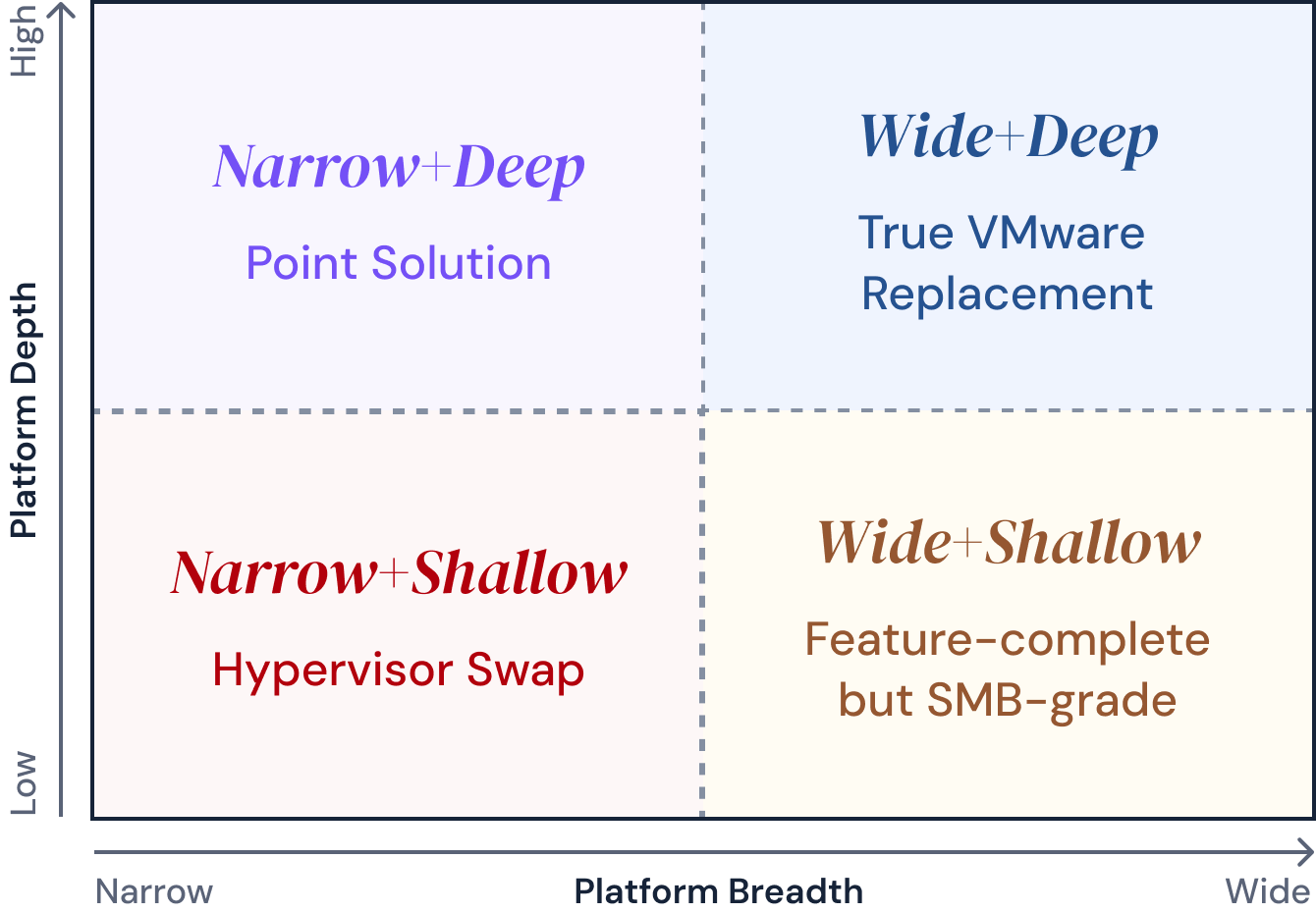
Plotting breadth against depth produces four categories based on vendor capabilities evaluation:
- Narrow + Shallow (hypervisor swap): fails 8+ breadth capabilities immediately. Fast to deploy, expensive to complete. Examples: bare Proxmox, HPE VM Essentials.
- Narrow + Deep (point solution): excellent in one or two layers; requires 3+ additional vendors to cover the rest. Creates re-fragmentation. Examples: Red Hat OpenShift Virtualization.
- Wide + Shallow (feature-complete but SMB-grade): passes the breadth checklist on paper; collapses under Tier-1 enterprise workloads at scale. Gaps surface 12–18 months post-migration. Examples: Azure Local.
- Wide + Deep (true VMware replacement): covers all 8 capability areas natively and meets enterprise-grade depth criteria at each layer. The only quadrant that eliminates re-fragmentation risk over a 5-year horizon. Examples: Nutanix NCI and Arcfra AECP.
Download the Whitepaper for VMware Alternative Evaluation
For a complete Breadth-Depth (2x2) evaluation framework, six top vendor comparisons, and a 56-question evaluation checklist, download the white paper: Beyond the Hypervisor Swap: Why VMware Replacement Demands Both Platform Breadth and Depth.
Arcfra simplifies enterprise cloud infrastructure with a full-stack, software-defined platform built for the AI era. We deliver computing, storage, networking, security, Kubernetes, and more — all in one streamlined solution. Supporting VMs, containers, and AI workloads, Arcfra offers future-proof infrastructure trusted by enterprises across e-commerce, finance, and manufacturing. Arcfra is recognized by Gartner as a Representative Vendor in full-stack hyperconverged infrastructure. Learn more at www.arcfra.com.