
What Functional Capabilities Are Required to Replace the VMware Stack?
Key Takeaways
Replacing the full VMware stack requires more than VM lifecycle management. A VMware alternative should cover eight core capability areas: compute virtualization, software-defined storage, integrated Kubernetes, disaster recovery, software-defined networking, operations and management, migration, and ecosystem integration. Enterprises should also confirm whether each capability is native, bundled, add-on, cloud-delivered, or dependent on third-party tools.
What Functional Capabilities Are Required to Replace the Full VMware Stack?
Enterprises should evaluate VMware alternatives across two independent axes: platform breadth and platform depth. While the depth asks if the capability the platform claims to cover actually meets enterprise-grade requirements, the breadth asks if the platform covers every functional layer that the VMware stack covers.
Eight capability areas — spanning thirty-two testable criteria — constitute the minimum breadth checklist for a true VMware replacement:
- Compute Virtualization
Hypervisor + VM lifecycle management; live migration; VM placement control (affinity/anti-affinity groups); CPU/NUMA/SR-IOV/PCI passthrough support; VM encryption, secure boot, and TPM.
- Software-Defined Storage
Distributed block storage with RF2/RF3 replication and erasure coding; data localization (local replica on the VM host); no single-disk or single-controller bottleneck; storage data services (encryption, snapshots, clones) included natively.
- Integrated Kubernetes
Production-grade container orchestration native to the platform (not a separately deployed or cloud-delivered add-on); platform and K8s lifecycle managed together; GPU-schedulable; VM and container workload colocation on shared infrastructure; integrated stack with CSI, CNI and observability; DR for K8s cluster.
- Disaster Recovery (DR)
Aligns with the defined RPO/RTO for your applications and covers the full data protection spectrum: agentless and VM-consistent backup; async/sync replication to a secondary site with DR drill capability or cross-site active-active with automatic failover and zero data loss; automated failback, boot ordering, dependency mapping, and DR runbook orchestration.
- Software-Defined Networking (SDN)
Covers the full network and security stack: virtual switching, VLAN, and VxLAN routing; distributed firewall with workload-identity-based micro-segmentation; integrated load balancing for VM and container workloads; VPC-level tenant network isolation; all on-premises native, not cloud-delivered.
- Operation and Management (O&M)
A full-featured enterprise infrastructure management platform must deliver VM and cluster lifecycle management, performance monitoring and capacity planning, compliance enforcement, non-disruptive rolling upgrades across the full stack — including firmware, hypervisor, storage, networking, and Kubernetes — and unified observability across all layers from a single operational interface.
Two adjacent VMware capabilities are frequently raised but should not drive platform selection. Self-service automation (Aria/vRealize Automation) is a workflow layer above infrastructure management, not part of it. Native REST APIs and IaC tooling (Terraform, etc.) available on the evaluated platform provide a more portable foundation; Aria parity is an automation strategy decision, not a platform criterion. Multi-tenant virtual data center use cases (vCloud Director) are specific to service providers or enterprises running formal chargeback models. For most enterprise workloads, VPC-level network isolation in the SDN layer addresses the actual requirement — organizations should confirm whether the use case is genuine multi-tenancy or conventional workload isolation before treating vCD replacement as a hard requirement.
- Migration
Native, agentless V2V migration from VMware without requiring a third-party tool; source VMs remain online throughout the full data copy phase with incremental CBT delta sync before cutover; automatic paravirtual driver injection at the destination; automated network configuration mapping; source VM remains intact and recoverable until the operator confirms cutover success; orchestrated wave migration with sequencing and dependency controls.
For large-scale VM deployment, you also need to evaluate migration performance and reporting capability for the migration tool:
Performance: scalable concurrent transfer engine with automatic load-based worker scheduling for large-scale migration throughput;
Reporting: real-time per-VM progress tracking with execution records exportable as CSV or PDF.
- Ecosystem & Integration
Breadth and maturity of the surrounding partner ecosystem across four sub-layers — backup/recovery ISVs, disaster recovery (native + third-party), certified hardware partners, and enterprise application/ISV certifications.
Download the Whitepaper for VMware Alternative Evaluation
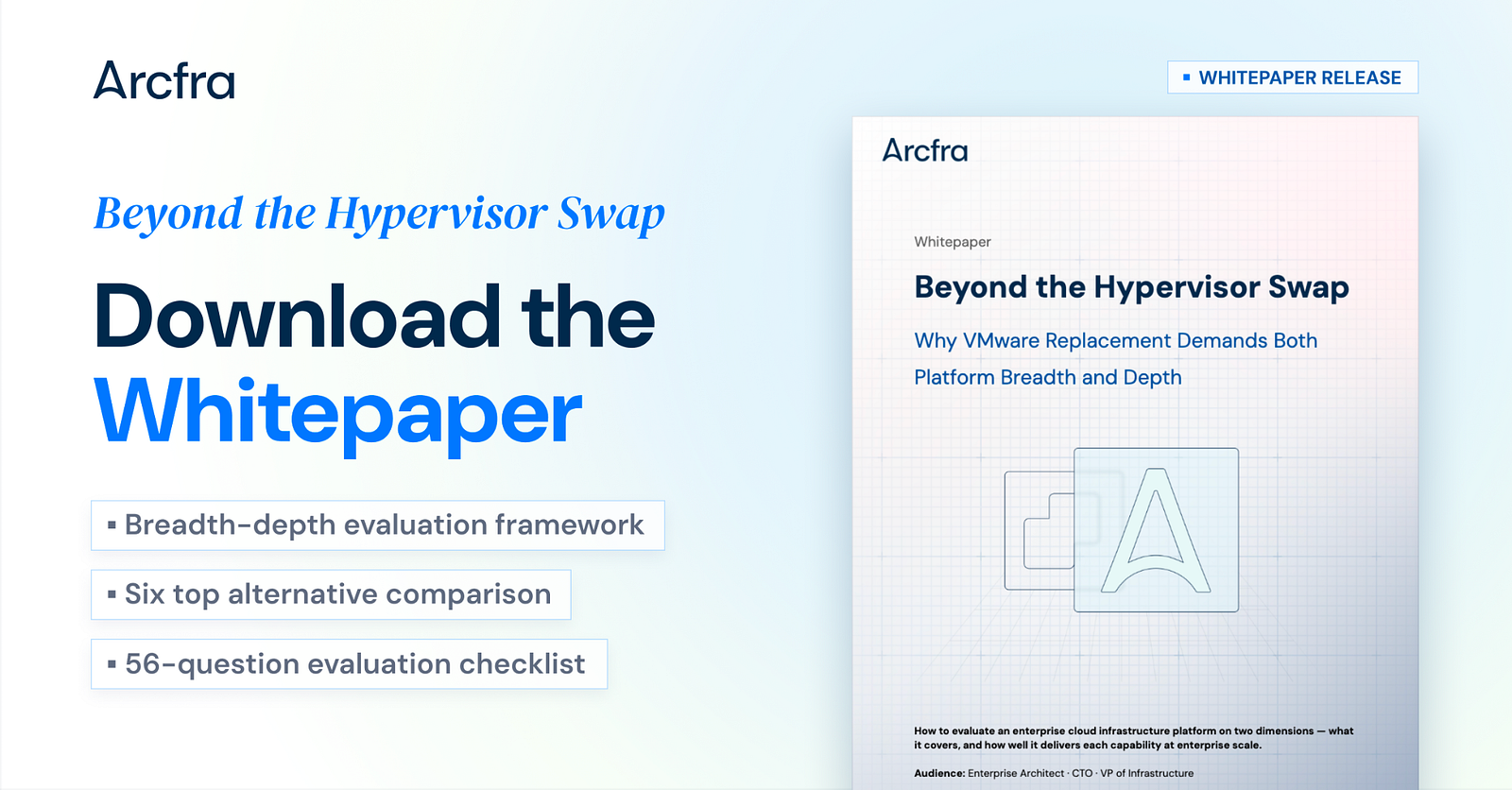
For a complete Breadth-Depth (2x2) evaluation framework, six top vendor comparisons, and a 56-question evaluation checklist, download the white paper: Beyond the Hypervisor Swap: Why VMware Replacement Demands Both Platform Breadth and Depth.
Arcfra simplifies enterprise cloud infrastructure with a full-stack, software-defined platform built for the AI era. We deliver computing, storage, networking, security, Kubernetes, and more — all in one streamlined solution. Supporting VMs, containers, and AI workloads, Arcfra offers future-proof infrastructure trusted by enterprises across e-commerce, finance, and manufacturing. Arcfra is recognized by Gartner as a Representative Vendor in full-stack hyperconverged infrastructure. Learn more at www.arcfra.com.