
How to Evaluate the Performance of VMware Alternatives?
Key Takeaways
Storage performance is determined by architecture, not hardware alone. Key evaluation dimensions: data locality, I/O path efficiency, storage parallelism, RDMA networking, data auto-tiering, and hardware offload. Benchmark at high utilization (>80%), during concurrent rebuild activity, and across deep snapshot chains — not on an idle cluster.
How to Evaluate the Performance of VMware Alternatives?
For mission-critical applications — databases, ERP, real-time analytics — and AI/ML workloads where GPU idle cycles directly translate to wasted infrastructure spend, storage performance is the most consequential architectural variable in any infrastructure platform decision. Storage performance in HCI is determined by I/O path architecture, not hardware alone. Five dimensions determine real-world throughput under production load:
Data locality: One replica on the VM’s local node eliminates cross-node read hops. Architectures without locality preference add network latency to every read under normal operation.
I/O path efficiency: Kernel-bypass access (io_uring, SPDK) removes OS overhead from every I/O. Controller-VM architectures add a processing hop and permanently reserve host CPU and memory — typically 6–10% per node — regardless of workload demand, creating a performance ceiling that tightens at high utilization.
Storage parallelism: Extent striping across multiple devices eliminates single-disk bottlenecks during normal operation and recovery.
RDMA networking: Direct memory access across 10/25/100GbE storage fabric bypasses the CPU and OS network stack, preventing the network from becoming the throughput ceiling for storage-intensive and GPU-bound workloads.
Hardware offload: Dedicated engines (compression, copy, CRC) move auxiliary operations off the CPU, preserving compute for application workloads.
Benchmark at ≥80% utilization, during concurrent rebuild activity, and across deep snapshot chains — not on an idle cluster.
Download the Whitepaper for VMware Alternative Evaluation
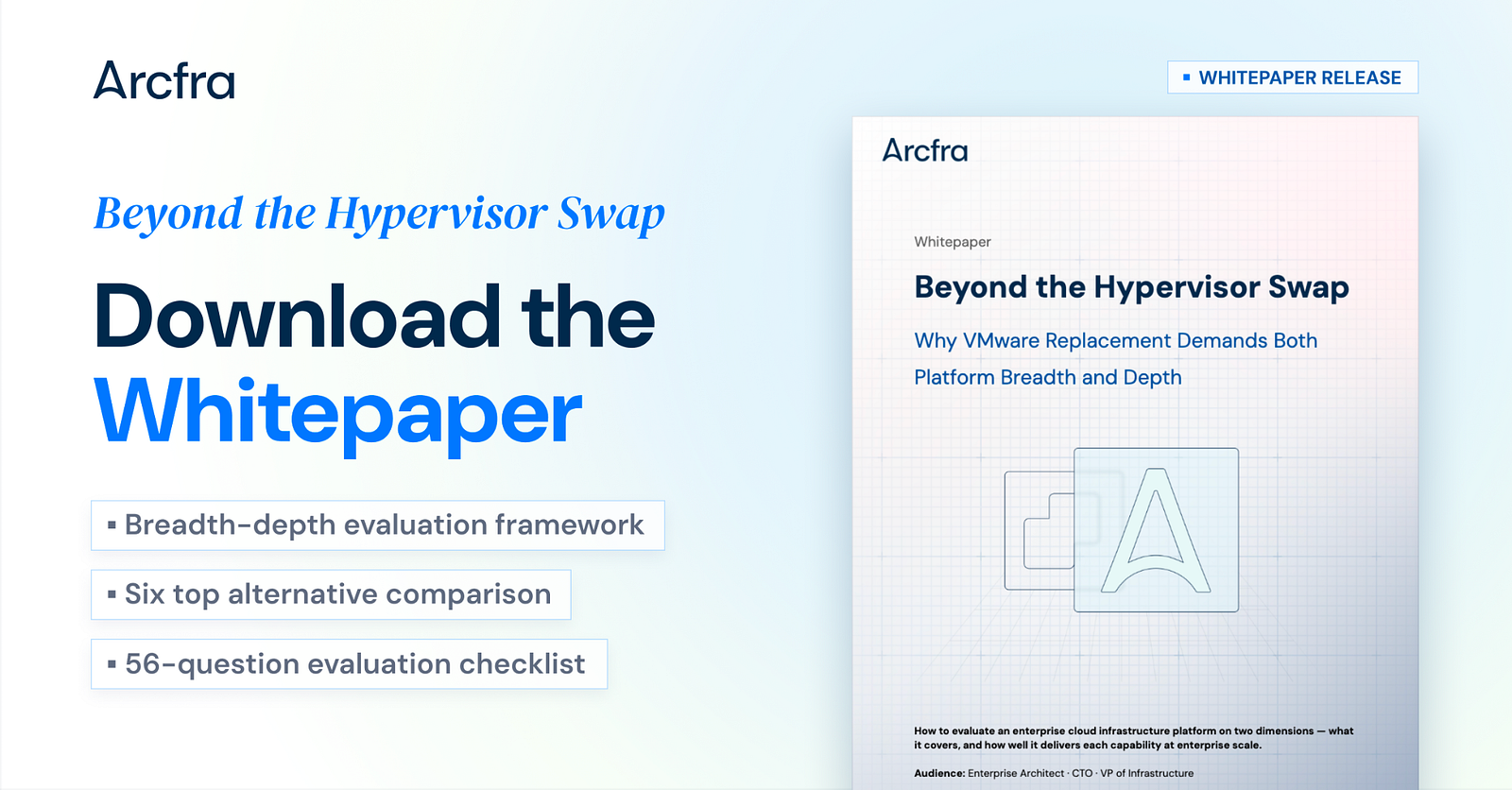
For a complete Breadth-Depth (2x2) evaluation framework, six top vendor comparisons, and a 56-question evaluation checklist, download the white paper: Beyond the Hypervisor Swap: Why VMware Replacement Demands Both Platform Breadth and Depth.
Arcfra simplifies enterprise cloud infrastructure with a full-stack, software-defined platform built for the AI era. We deliver computing, storage, networking, security, Kubernetes, and more — all in one streamlined solution. Supporting VMs, containers, and AI workloads, Arcfra offers future-proof infrastructure trusted by enterprises across e-commerce, finance, and manufacturing. Arcfra is recognized by Gartner as a Representative Vendor in full-stack hyperconverged infrastructure. Learn more at www.arcfra.com.