
Is Your VMware Alternative AI-Ready? | Evaluation Framework
Key Takeaways
An AI-ready VMware alternative should provide more than GPU passthrough. It should support RDMA-optimized storage-to-GPU data paths in production, allow VM and container workloads to share the same physical node pool, and provide vGPU, MIG, HA coverage for GPU workloads, and on-premises model lifecycle support without forcing a separate AI cluster or cloud dependency.
How to Evaluate if a VMware Alternative is AI-Ready?
AI-ready infrastructure requires RDMA-optimized storage-to-GPU data paths, native VM/container colocation, vGPU/MIG GPU pooling with HA coverage, and on-premises AI model lifecycle support — not a separate cluster or cloud dependency.
The GPU-storage data path is the primary bottleneck for effective GPU utilization. Traditional storage paths (iSCSI, NFS) introduce enough latency to cause GPU idle cycles during model loading, directly reducing throughput and ROI. RDMA storage paths bypass the CPU and OS network stack entirely, eliminating this bottleneck. Evaluate whether RDMA-native storage paths are available in production today — not on a roadmap.
VM and container colocation on the same physical node pool is the second requirement. A platform requiring a separate AI cluster or cloud dependency is AI-deferred, not AI-ready. For regulated industries, sovereign on-premises inference must be achievable without cloud control-plane dependencies.
GPU resource pooling: Platforms supporting only GPU passthrough enforce a 1:1 GPU-to-VM model, leaving expensive accelerators underutilized between workloads. vGPU support enables GPU sharing across multiple VMs while preserving live migration capability. MIG (Multi-Instance GPU) provides hardware-level partitioning on A100/H100/H200 — dedicated compute, memory, and bandwidth per instance — enabling true multi-tenant isolation. Critically, vGPU VMs must be covered under the platform’s standard HA policy; passthrough VMs cannot live-migrate and are excluded from HA protection.
AI model lifecycle: On-premises AI deployment requires a local model repository for versioning and managing model weights, and an API-compatible inference gateway that redirects existing applications from public cloud APIs to on-premises GPUs without code changes.
Download the Whitepaper for VMware Alternative Evaluation
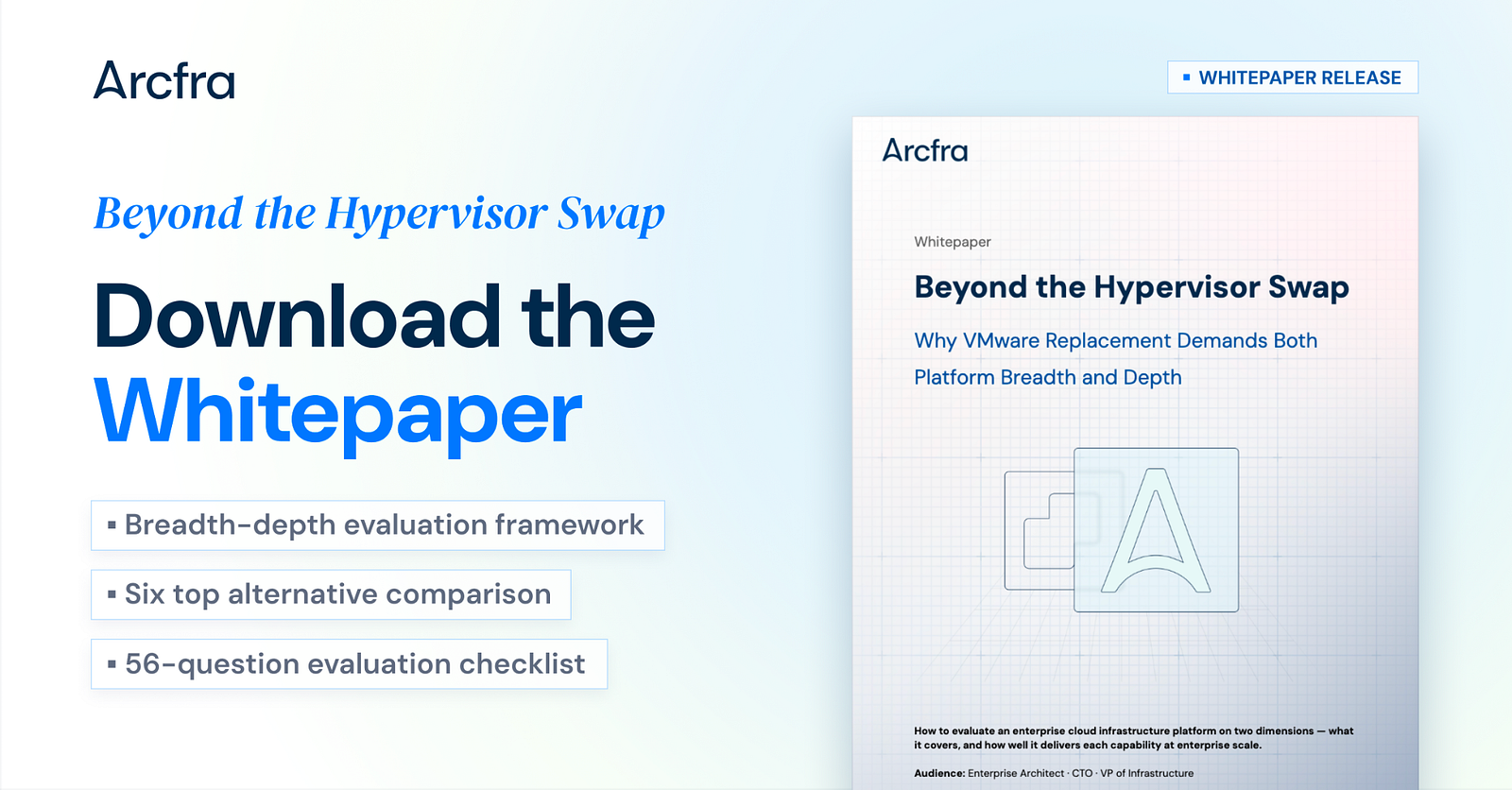
For a complete Breadth-Depth (2x2) evaluation framework, six top vendor comparisons, and a 56-question evaluation checklist, download the white paper: Beyond the Hypervisor Swap: Why VMware Replacement Demands Both Platform Breadth and Depth.
Arcfra simplifies enterprise cloud infrastructure with a full-stack, software-defined platform built for the AI era. We deliver computing, storage, networking, security, Kubernetes, and more — all in one streamlined solution. Supporting VMs, containers, and AI workloads, Arcfra offers future-proof infrastructure trusted by enterprises across e-commerce, finance, and manufacturing. Arcfra is recognized by Gartner as a Representative Vendor in full-stack hyperconverged infrastructure. Learn more at www.arcfra.com.