
From Model Deployment to Model Operations: Six Challenges in Building a Private Enterprise MaaS Platform
As LLM adoption expands from isolated pilots to production use cases, enterprises are no longer managing a single model or application. They are managing multiple teams, model types, inference workloads, and business systems at the same time.
Enterprises need more than one working model deployment. They need a continuous, stable, secure, and governable foundation that can deliver a steady stream of model capabilities to complex business lines through standard services. This is why more organizations are building private Model-as-a-Service (MaaS) platforms that can unify compute capacity, schedule model services, and govern model invocations at a granular level.
Six Common Challenges in Private MaaS Deployments
When enterprises build a private AI base, problems tend to appear across resources, models, services, and governance. If teams handle those layers separately, the platform can become hard to control as a system.
#1 GPU Resources Are Fragmented and Underused
Business units and technical teams often compete for GPU resources to run their own workloads. Large models, small models, embedding models, reranking models, and OCR workloads then run in mixed, scattered environments. Some lightweight or low-traffic services reserve entire high-end GPUs for long periods, which leaves expensive compute capacity underused.
End User Story: As a large healthcare organization introduced more model sources and model types, it also needed stronger platform governance. They had deployed new models on shared compute resources. Smaller embedding, reranking, and OCR models did not need full GPU cards for long-running inference. They wanted a unified model service platform for private inference, with GPU virtualization, unified routing, quota management, invocation logs, and observability. The goal was to govern heterogeneous compute, different model types, and multiple user groups in a unified way.
#2 LLMs, Traditional ML Models, and External APIs Are Hard to Manage Together
Enterprises often run open-source large models, commercially licensed models, industry-specific fine-tuned models, and traditional machine learning (ML) models in the same infrastructure. These models use different inference frameworks, APIs, and release cycles, while management practices often lack standardization.
End User Story: Another healthcare organization used two groups of models. One group covered LLMs from medium-sized to very large models, with shared deployment and invocation. The other group covered smaller traditional ML and image-recognition models for research and medical imaging, where teams cared more about compute delivery itself. They needed one platform to manage both model resources and compute resources, so it could support large-parameter models while still deploying and delivering smaller models on demand.
#3 Applications Tightly Coupled to Specific Models
Without a unified proxy or abstraction layer, business applications often hard-code calls to a specific model instance or inference interface. Once the team upgrades a model, switches backends, runs a canary release, or fails over to a different service, many upstream applications need code changes and redeployment.
#4 Inference Services Take Too Long to Bring Online
Teams repeat the same groundwork every time they bring a model into production: prepare model files, configure the runtime, adapt the inference framework, bind compute resources by hand, and expose a standard API. This work slows down rollout and consumes engineering time that should go into the application.
#5 Black-Box Invocations Limit Governance
Without a unified invocation hub, platform teams cannot track invocation volume or compute consumption by department, application, or model. Quota management, fine-grained rate limiting, behavior compliance audits, and internal cost allocation then lack the usage data they need.
#6 Operational Complexity Builds Up Fast
Private environments often run many large models, branch versions, inference backends, and business applications at the same time. When latency or timeouts appear, teams have to trace requests across all of them. Capacity planning and performance tuning become guesswork without consistent telemetry.
The Key: From Model Deployment to Model Operations
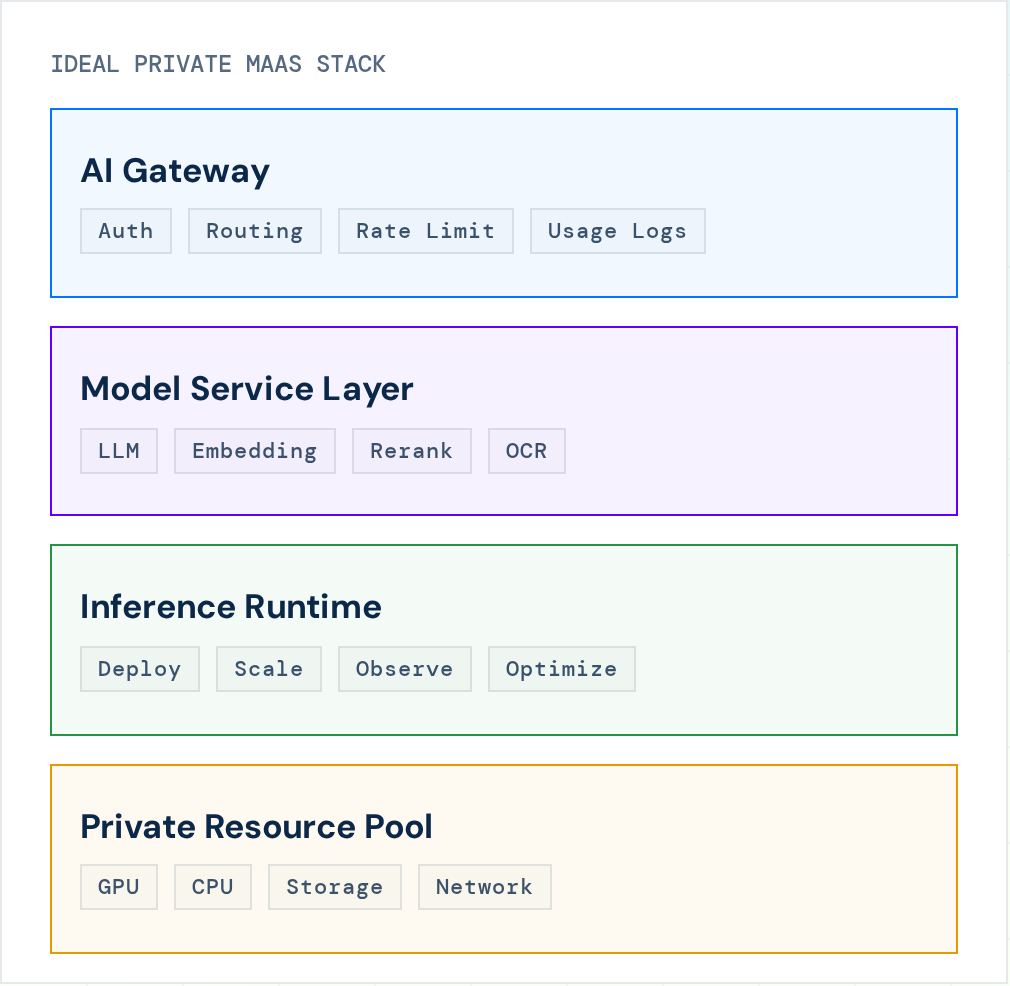
A private enterprise MaaS platform should consolidate compute into an elastic resource pool, package model capabilities as standard services, and enforce governance between the two. With this structure, teams can replace models, expand compute, and reuse AI services across applications without rebuilding each integration.
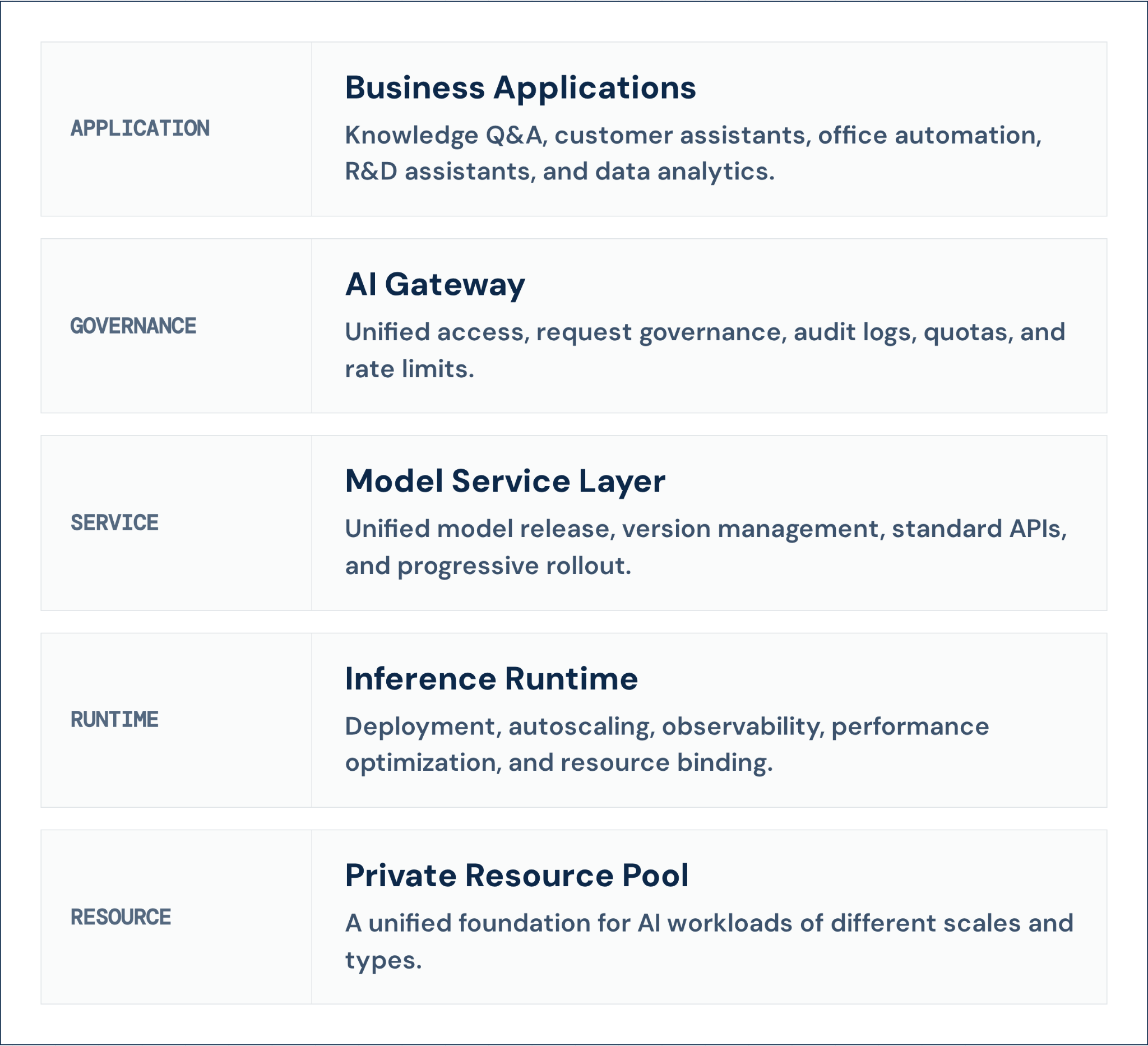
- Private resource pool: Manages all heterogeneous infrastructure across public cloud environments and enterprise data centers, including GPU compute, high-performance CPU, distributed object/file storage, and low-latency RoCE/InfiniBand networking for AI workloads of different sizes and types.
- Inference runtime: Turns model files into running services through integrated automated deployment, elastic scaling, and inference engine acceleration.
- Model service layer: Abstracts diverse inference instances into standard APIs, supports unified model publishing and management, and separates applications from the underlying architecture.
- Service governance layer: Uses AI Gateway as the unified access point for invocation traffic, with real-time observability, authentication, and secure quota governance.
- Application consumption layer: Gives business applications a consistent interface for consuming model capabilities without binding each application to a specific model, runtime, or hardware environment.
 How Arcfra AECP + Neutree Support Private MaaS Operation
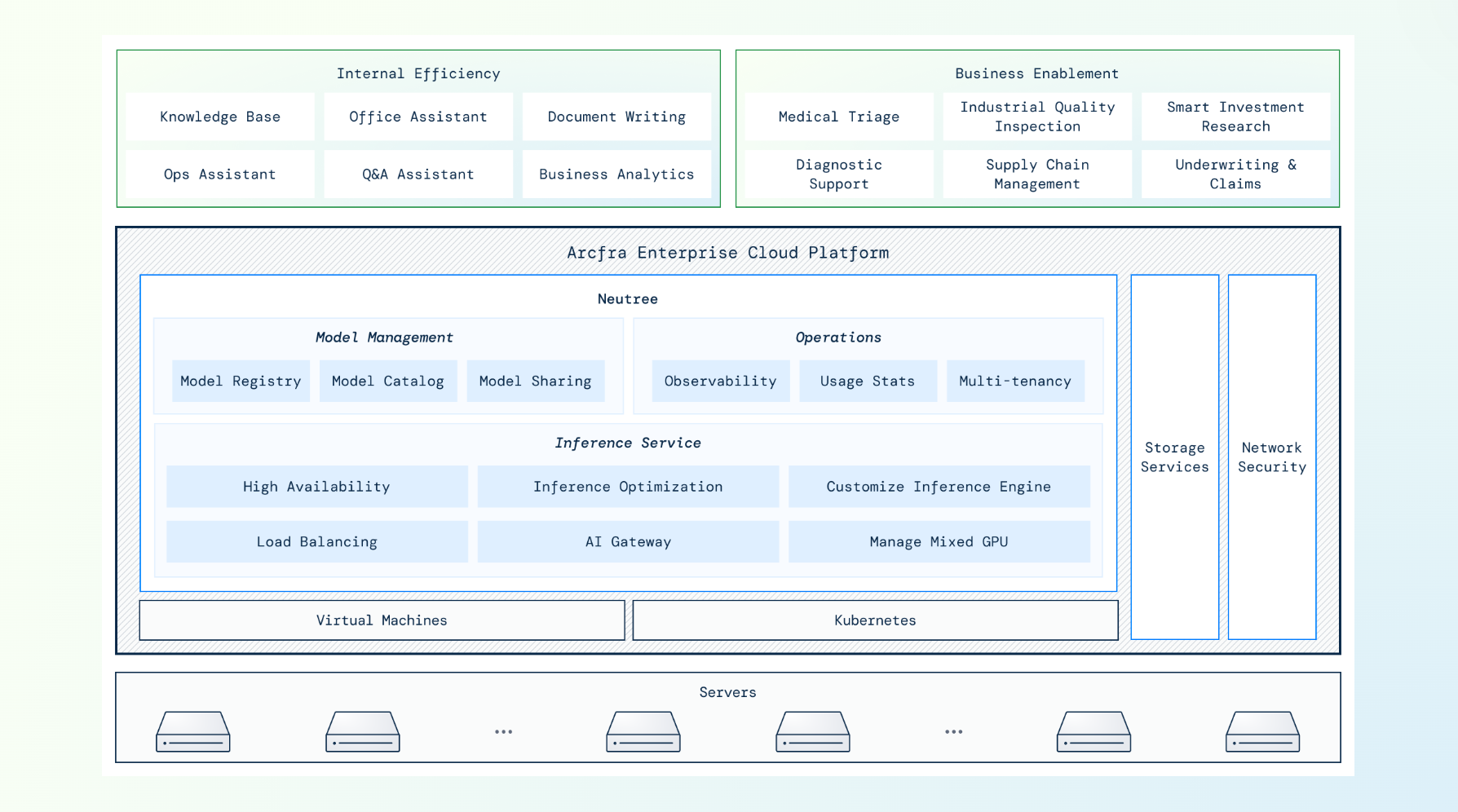
Arcfra combines Arcfra Enterprise Cloud Platform (AECP) and Arcfra Neutree to bring compute consolidation, model management, standard services, and model governance into one delivery path for private enterprise AI infrastructure. AECP provides the infrastructure foundation for heterogeneous compute pooling, scheduling, and resource delivery. Neutree provides the model service layer, API standardization, AI Gateway, governance, and observability capabilities. Together, they help enterprises operate models as shared services rather than isolated deployments.
Unified Compute Resource Pool
AECP brings scattered and idle physical GPUs and CPU resources under central management, breaking down the asset barriers created by department-level silos. Business lines can request resources on demand, and the platform schedules large models, small models, and other workloads across the shared pool. This can improve utilization compared with fragmented, department-level allocation.
Unified Model Management
Teams can build a centralized enterprise model catalog and register open-source foundation models, industry fine-tuned models, self-developed lightweight models, and commercial external APIs in a standard way. The platform also supports online/offline controls and lifecycle version tracking.
Standardized Model Services
The platform abstracts complex underlying model services into standard, industry-compatible APIs, including OpenAI-compatible interfaces where needed. Business systems do not need to know which inference engine or framework runs underneath. Teams can switch traffic between model services with less application-side work.
Unified Inference Service Delivery
The automatic delivery pipeline covers model file preparation, runtime image packaging, optimal resource binding, and endpoint exposure. Work that used to take weeks can move to hours, or minutes in simpler cases.
Governance Through AI Gateway
AI Gateway gives the enterprise one traffic entry point for model consumption. It supports multi-level role-based authentication, fine-grained routing, quota limits, rate controls, and compliance audits for prompts and completions. Platform teams can manage usage by department, application, and model.
Observability and Operations
The platform tracks model instance health, GPU utilization, network throughput, and invocation records.. Detailed gateway invocation records give operations teams the data they need for troubleshooting, long-term capacity planning, and cost allocation.
These capabilities apply across common enterprise AI scenarios where multiple teams need to share model services without duplicating infrastructure.
- Enterprise knowledge Q&A: Departments share centrally managed language models and dense vector retrieval capabilities. The centralized gateway assigns data access permissions to applications by level and department, so teams can share knowledge assets without losing access control.
- Customer service and agent assistants: The platform supports high-concurrency internal and external calls with stable inference responses, then reallocates compute in the shared pool as traffic changes during the day. This helps teams handle peak demand without dedicating fixed hardware to each service.
- Office and workflow automation: Internal workflow systems, approval processes, and enterprise applications can reuse the same group of large models at low latency. Departments no longer need to buy hardware and deploy models for each application.
- R&D and data analysis assistants: For compute-intensive work such as code generation, multi-table query analysis, and business report generation, the platform can match the right compute resources with task-specific fine-tuned models.
- Cross-model evaluation and canary release: Teams can introduce new models online, compare them with existing models through A/B tests across quality, cost, and latency, and shift traffic from the old model to the new one through AI Gateway without changing the application.
Core Business Value: Operationalizing Enterprise AI at Scale
- Reduce duplicated AI infrastructure investment: Teams deploy a model once and reuse it across company systems. Central resource planning reduces idle hardware caused by fragmentation and improves return on hardware investment (ROI).
- Accelerate AI application delivery: Standardized and automated engineering workflows reduce repeated work. Teams can shorten the full cycle from model selection and fine-tuning to production use by business applications.
- Strengthen governance and compliance: Model usage becomes visible, traceable, and controllable. Platform teams can see traffic flows, compute quotas, rate limits, and security audit records, which gives technology teams the data they need for fine-grained AI audits and financial cost tracking.
- Reduce lock-in to one model or vendor: Applications connect to standard APIs. When open-source models evolve, hardware changes, or commercial model pricing shifts, teams can replace, upgrade, or migrate the underlying resources while keeping application interfaces stable.
- Scale AI adoption across teams and business units: The platform removes coordination bottlenecks across teams, business domains, and high-concurrency use cases, helping enterprise AI move from isolated projects to group-wide operations.
Learn more about enterprise AI infrastructure, unified full-stack platforms and AI operation workflows:
Powering AI Workloads with Arcfra: A Unified Full-Stack Platform for the AI Era
Arcfra Launches Neutree: Bridging the Gap Between AI Experimentation and Enterprise Production
Arcfra simplifies enterprise cloud infrastructure with a full-stack, software-defined platform built for the AI era. We deliver computing, storage, networking, security, Kubernetes, and more — all in one streamlined solution. Supporting VMs, containers, and AI workloads, Arcfra offers future-proof infrastructure trusted by enterprises across e-commerce, finance, and manufacturing. Arcfra is recognized by Gartner as a Representative Vendor in full-stack hyperconverged infrastructure. Learn more at www.arcfra.com.