
VMware Alternative Matrix 2026: Arcfra AECP, Nutanix NCI, Microsoft Azure Local, Proxmox VE, HPE VM Essentials, and RedHat OpenShift Virtualization
Key Takeaways
Among the six representative VMware alternatives (Arcfra AECP, Nutanix NCI, Microsoft Azure Local, Proxmox VE, HPE VM Essentials, and Red Hat OpenShift Virtualization), enterprises should compare the same breadth and depth criteria across different architectural approaches. These platforms are not interchangeable VMware replacements; each has different strengths and constraints across storage, DR, SDN, operations, AI readiness, and hardware flexibility.
Alternative Platform Assessments: Breadth and Depth
Six platforms assessed against eight breadth capability areas and six depth dimensions.
- Platform Breadth (does it cover all capability layers the VMware stack covered?)
- Platform Depth (at each layer, does it meet enterprise-grade reliability, performance, scalability, security, AI-readiness, and hardware flexibility requirements?)
>>Learn more about the Breadth-Depth (2x2) evaluation framework
Legend: ✅ Bundled / Strong ⚠️ Partial / Add-on / Tier-gated ❌ Not Available
Axis 1 — Platform Breadth Scorecard
Does this platform cover each of the eight functional capability areas?
| Capability Area | Nutanix NCI | Azure Local | Proxmox VE | HPE VME | OpenShift Virt | Arcfra AECP |
|---|---|---|---|---|---|---|
| Compute Virtualization | ✅AHV; ⚠️ Starter 12-node cap | ✅Hyper-V; live migration | ✅KVM; no DRS/auto-placement | ✅HVM; no anti-affinity | ⚠️KubeVirt; K8s-native model | ✅AVE + ESXi; SR-IOV; vGPU |
| Software-Defined Storage | ✅DSF; RF2/RF3; inline opts | ✅S2D RDMA | ⚠️Ceph only; no QoS/policy | ⚠️External only; no native HCI | ⚠️ODF/Ceph — separate license | ✅ABS/AFS; no CVM overhead |
| Integrated Kubernetes | ⚠️NKP w/ Pro/Ultimate only | ✅AKS on Azure Local bundled | ❌No native K8s or CNI | ⚠️MKS — Enterprise tier only | ✅OpenShift is the K8s platform | ✅AKE bundled; active-active K8s |
| Disaster Recovery | ⚠️Leap — separate license required3P backup integration;Sync/Async /near Sync ReplicationMetro-cluster | ⚠️Azure Backup/ASR; Azure required | ❌vzdump only; no orchestration | ⚠️No native backup; Alletra HW for stretch cluster | ⚠️OADP basic; Kasten 3rd-party | ✅Native agentless backup;3P backup integration;Sync/Async ReplicationA-A |
| SDN / Micro-Segmentation | ⚠️Flow — Pro/Ultimate only | ⚠️Azure Arc-delivered; cloud req'd | ⚠️iptables only; no DFW or LB | ⚠️Juniper HW req.; no LB bundled | ⚠️NS-scoped policy; no DFW equiv | ✅ANS DFW + VPC + LB bundled |
| Operations & Management | ✅Prism Central; Prism Pro extra | ⚠️Azure Arc; cloud connect. Req'dWindows User Experience | ⚠️Per-cluster; no federationRaw UI for VM admins | ⚠️Morpheus unified consoleAutomation-first UI, different user experience | ⚠️OpenShift console; K8s-nativeK8s user experience to manage VM | ✅AOC — single pane; full-stack;Similar user experience of VMware |
| Migration | ✅Nutanix Move; agentless warm | ⚠️Azure Migrate; no air-gap | ⚠️Import Wizard; cold/offline only | ⚠️VMDK tool; cold; 20 VM max | ⚠️MTV included; limited at scale | ✅warm/live; Advanced architecture. |
| Ecosystem & Integration | ✅Broadest | ✅Broad | ⚠️Developing | ⚠️Developing | ⚠️Operator ecosystem focus on Cloud Native | ⚠️Developing |
Axis 2 — Platform Depth Scorecard
At each layer, does the platform meet enterprise-grade requirements?
| Depth Dimension | Nutanix NCI | Azure Local | Proxmox VE | HPE VME | OpenShift Virt | Arcfra AECP |
|---|---|---|---|---|---|---|
| HA & Resilience | ⚠️ 6/9 scenarios; VM-NIC / SR-IOV / vGPU gaps; NGT agent required for guest OS heartbeat | ⚠️ 5/9 scenarios; no per-VM NIC monitoring; SR-IOV/DDA VMs excluded from live migration | ❌ 3/9 scenarios; no guest OS heartbeat; no SR-IOV/vGPU HA | ❌ 3/9 scenarios; stretch cluster requires Alletra HW; multiple scenarios undocumented | ⚠️ VM HA is K8s control-plane dependent; passes few VM-specific scenarios; best for container workloads | ✅ 9/9 scenarios; only platform explicitly covering VM-NIC / guest OS / SR-IOV / vGPU; temp replica maintained during rebuild |
| Performance | ⚠️ CVM permanently reserves 6–10% compute per node; data locality ✅ | ✅ No CVM; S2D kernel-native; SMB Direct/RoCE RDMA; data locality less strict than DSF/ABS | ⚠️ No CVM; Ceph has no data locality / no RDMA; performance degrades at high utilization without expert tuning | ⚠️ No CVM but external storage only; no data locality; RDMA via HPE Alletra hardware only | ⚠️ KubeVirt pod wrapper adds per-VM overhead; ODF/Ceph shares same locality and RDMA gaps as Proxmox | ✅ No CVM; local replica on VM host; io_uring; Intel DSA offload; RDMA cross-NIC bonding |
| Scalability | ⚠️ Starter capped at 12 nodes; Pro/Ultimate required for 64-node scale — cluster expansion triggers full license renegotiation | ⚠️ 16-node converged cluster ceiling (64 disaggregated); multi-cluster via Azure Arc required beyond | ⚠️ No license caps; Corosync/Ceph operational complexity at scale; no enterprise multi-cluster federation | ⚠️ HPE-centric HCL constrains growth; Morpheus Enterprise required for larger environments | ✅ No cluster size caps; K8s scales to hundreds of nodes; compute/storage nodes cleanly separable | ✅ No node count / capacity / K8s cluster limits at any license tier; multi-cluster federation via AOC |
| Security | ⚠️ Flow micro-segmentation and compliance monitoring gated behind Pro/Ultimate — base deployment has flat east-west network | ✅ Secured-core baseline; HVCI; Entra MFA; Azure Policy; advanced management requires cloud connectivity | ❌ no NSX-style workload-identity DFW; no compliance monitoring | ⚠️ Juniper zero-trust SDN requires Juniper HW + Apstra; DFW requires Aruba CX10K add-on; no native immutable snapshots | ✅ K8s RBAC; OPA/Gatekeeper; SELinux default; Compliance Operator; NetworkPolicy is namespace-scoped not VM-lifecycle-aware | ✅ ANS DFW bundled; micro-seg follows VMs through live migration; ABS immutable snapshots; all six pillars in base license |
| AI-Ready | ⚠️ vGPU + MIG + NKP supported; RDMA not purpose-built for AI; no on-prem model lifecycle or inference gateway | ⚠️ AI features deeply Azure cloud-dependent; local inference requires Azure connectivity | ❌ No K8s; no RDMA; no GPU pooling; no AI platform — not AI-adjacent | ❌ GPU passthrough only; no vGPU / no MIG; no AI platform or inference capability | ✅ Strongest vGPU/MIG scheduling via NVIDIA GPU Operator; VM+container GPU colocation native; RHOAI separately licensed | ✅ RDMA storage-to-GPU paths; vGPU + MIG with HA coverage; Neutree AI on-prem model lifecycle and inference — no cloud dependency |
| HW Flexibility | ⚠️ Limited multi-vendor HCL; mixed-vendor clusters; | ⚠️ OEM-validated list only; existing hardware typically needs replacement; no open commodity support | ✅ Most open of all six — runs on virtually any x86 hardware including repurposed assets | ❌ HPE ProLiant primary HCL; Alletra for RDMA/stretch; Juniper for SDN; Aruba for DFW — three flagship features each require specific proprietary hardware | ✅ Broad certified x86 HCL; bare metal on existing servers; K8s handles mixed hardware generations | ✅ Hardware-agnostic; mixed-vendor and mixed-generation in same cluster; existing servers onboardable |
Arcfra Enterprise Cloud Platform (AECP) is positioned as a full-stack VMware replacement with bundled capabilities across compute, storage, Kubernetes, DR, SDN, operations, migration, AI readiness, and hardware flexibility. Enterprises should evaluate it using the same POC and RFP criteria applied to other candidates.
Nutanix NCI represents a mature HCI-native alternative with strong market presence and a broad ecosystem. Evaluation should look closely at license tiers, cluster scale, advanced networking and DR licensing, and controller VM resource overhead.
Microsoft Azure Local is a strong fit for Microsoft-centric environments and Azure-connected operations. Enterprises should evaluate cloud connectivity requirements, Azure Arc dependency, cluster scale, and whether the operating model fits on-premises infrastructure teams.
Proxmox VE is attractive where openness, cost control, and hardware flexibility are primary goals. Enterprises should also assess gaps in native Kubernetes, DR orchestration, SDN, enterprise federation, and support model maturity.
HPE VM Essentials (VME) may fit HPE-centered environments, but evaluation should account for its dependency on specific HPE, Juniper, Aruba, or Alletra components for key capabilities.
Red Hat OpenShift Virtualization is strongest where Kubernetes is the primary operating model. It should be evaluated carefully for traditional VM operations, VM-specific HA, storage behavior, and DR expectations.
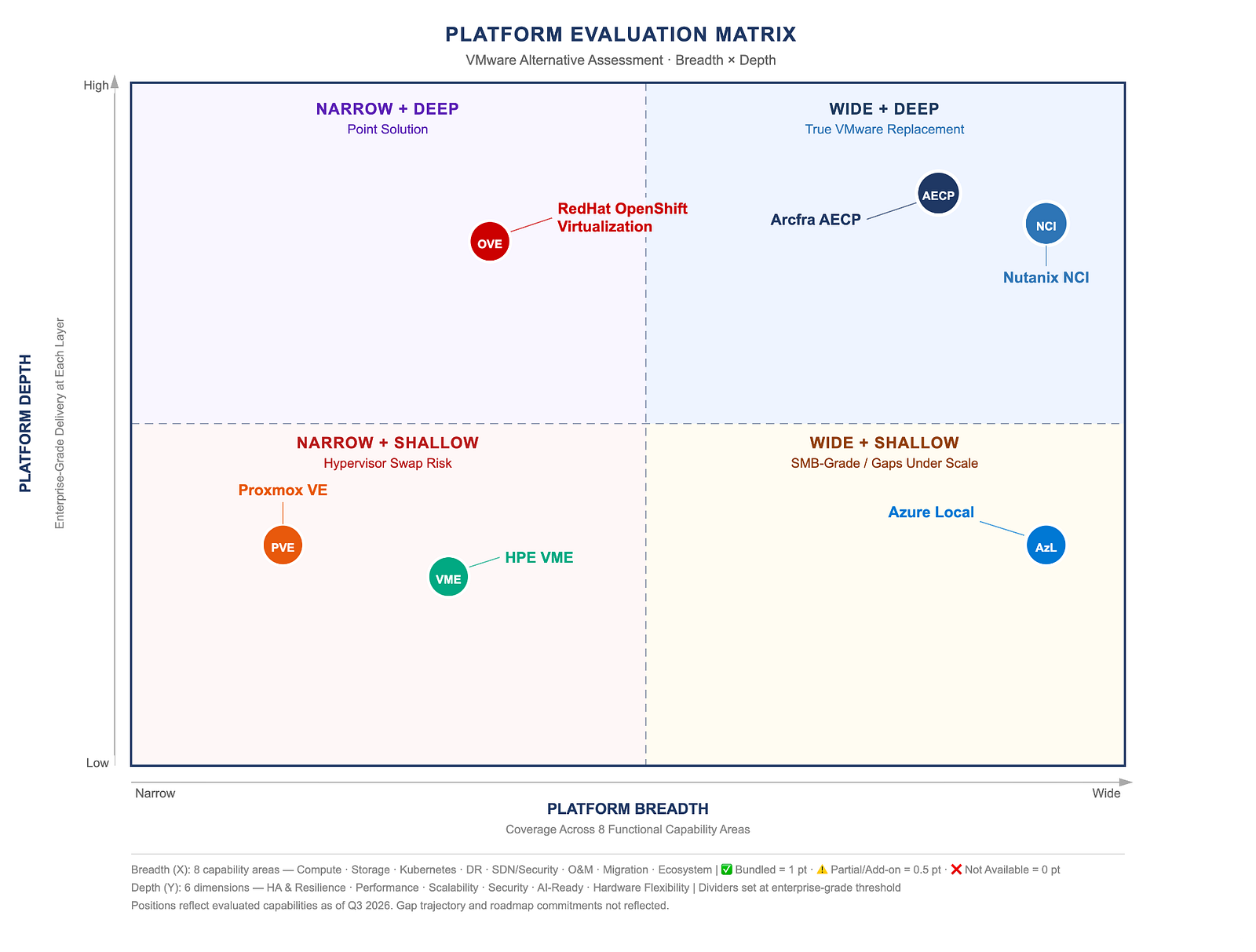
The 2×2 Platform Positioning Map
Plotting breadth against depth produces four vendor categories based on previous vendor capabilities evaluation:
- Narrow + Shallow (hypervisor swap): fails 8+ breadth capabilities immediately. Fast to deploy, expensive to complete. Examples: bare Proxmox, HPE VM Essentials.
- Narrow + Deep (point solution): excellent in one or two layers; requires 3+ additional vendors to cover the rest. Creates re-fragmentation. Examples: Red Hat OpenShift Virtualization.
- Wide + Shallow (feature-complete but SMB-grade): passes the breadth checklist on paper; collapses under Tier-1 enterprise workloads at scale. Gaps surface 12–18 months post-migration. Examples: Azure Local.
- Wide + Deep (true VMware replacement): covers all 8 capability areas natively and meets enterprise-grade depth criteria at each layer. The only quadrant that eliminates re-fragmentation risk over a 5-year horizon. Examples: Nutanix NCI and Arcfra AECP.
Download the Whitepaper for VMware Alternative Evaluation
For a complete Breadth-Depth (2x2) evaluation framework, six top vendor comparisons, and a 56-question evaluation checklist, download the white paper: Beyond the Hypervisor Swap: Why VMware Replacement Demands Both Platform Breadth and Depth.
Arcfra simplifies enterprise cloud infrastructure with a full-stack, software-defined platform built for the AI era. We deliver computing, storage, networking, security, Kubernetes, and more — all in one streamlined solution. Supporting VMs, containers, and AI workloads, Arcfra offers future-proof infrastructure trusted by enterprises across e-commerce, finance, and manufacturing. Arcfra is recognized by Gartner as a Representative Vendor in full-stack hyperconverged infrastructure. Learn more at www.arcfra.com.