
Why Memory Efficiency Is Becoming Critical for Agentic AI Infrastructure
Gartner’s inclusion of Arcfra in “Hype Cycle for Compute, 2026” highlights the growing importance of memory efficiency in enterprise infrastructure.
AI-driven demand for high-capacity memory is creating new pressure on component availability, hardware pricing, and I&O budgets. For infrastructure teams, memory is no longer just a server specification. It is becoming a strategic constraint that affects workload density, licensing efficiency, and the economics of Agentic AI infrastructure.
For years, infrastructure modernization was often discussed through the lens of CPU performance, GPU acceleration, storage IOPS, and network latency: more cores, faster accelerators, higher throughput, and lower latency. These remain important. But in many virtualized, database, AI inference, and data-intensive environments, another constraint is becoming more visible: memory.
In many enterprise environments, CPU utilization is not the first bottleneck. Memory capacity is. Hosts may still have compute headroom, but VM density cannot increase. At the same time, more software licensing models are moving toward core-based pricing, which puts more pressure on enterprises to run more workloads per host and extract more value from every licensed core.
This is why memory efficiency is becoming a strategic infrastructure topic. Enterprises need smarter ways to use memory resources, not only larger memory configurations. As AI workloads, database platforms, and virtualized environments increase pressure on DRAM capacity, memory efficiency is becoming a key requirement for sustainable infrastructure planning.
The Real Challenge: Memory Economics
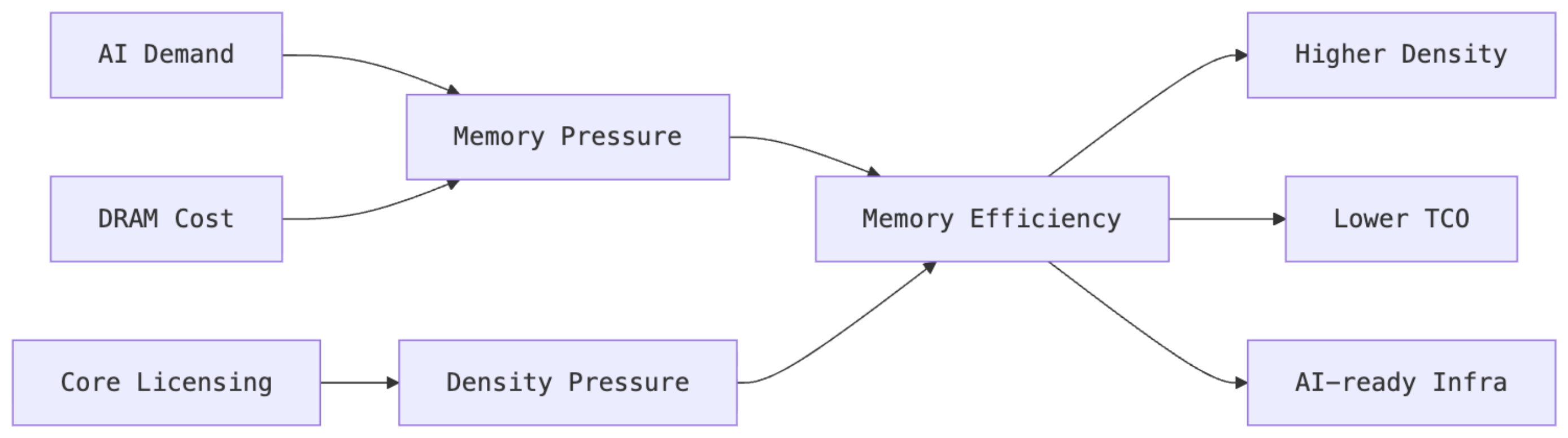
AI demand, rising DRAM costs, and core-based licensing are making memory efficiency a priority in infrastructure.
The rising cost of DRAM is making infrastructure planning harder. AI infrastructure build-out is increasing demand for high-capacity memory, while supply and pricing pressure directly affect server budgets. Adding more DRAM is still possible, but it is not always the most economical path.
The issue is especially clear in virtualized environments. Many enterprise applications do not actively use all the memory assigned to them at all times. Application demand has peaks and valleys. Different VMs rarely peak at the same moment. If infrastructure platforms reserve memory only based on static allocation, organizations are forced to provision for the worst case across all workloads.
The result is familiar: more hardware, but not necessarily better utilization.
Core-based licensing makes this tension sharper. When software costs are tied to CPU cores, enterprises naturally seek higher VM density per host. But VM density is often constrained by memory capacity rather than CPU. If memory utilization cannot improve, server hardware, software licenses, power, space, and operations are all underused.
Enterprises need more than additional hardware. They need smarter ways to use the resources they already have.
In other words, they need memory efficiency: higher memory utilization, greater workload density, and more predictable performance boundaries.
Arcfra’s Approach: Practical Memory Efficiency
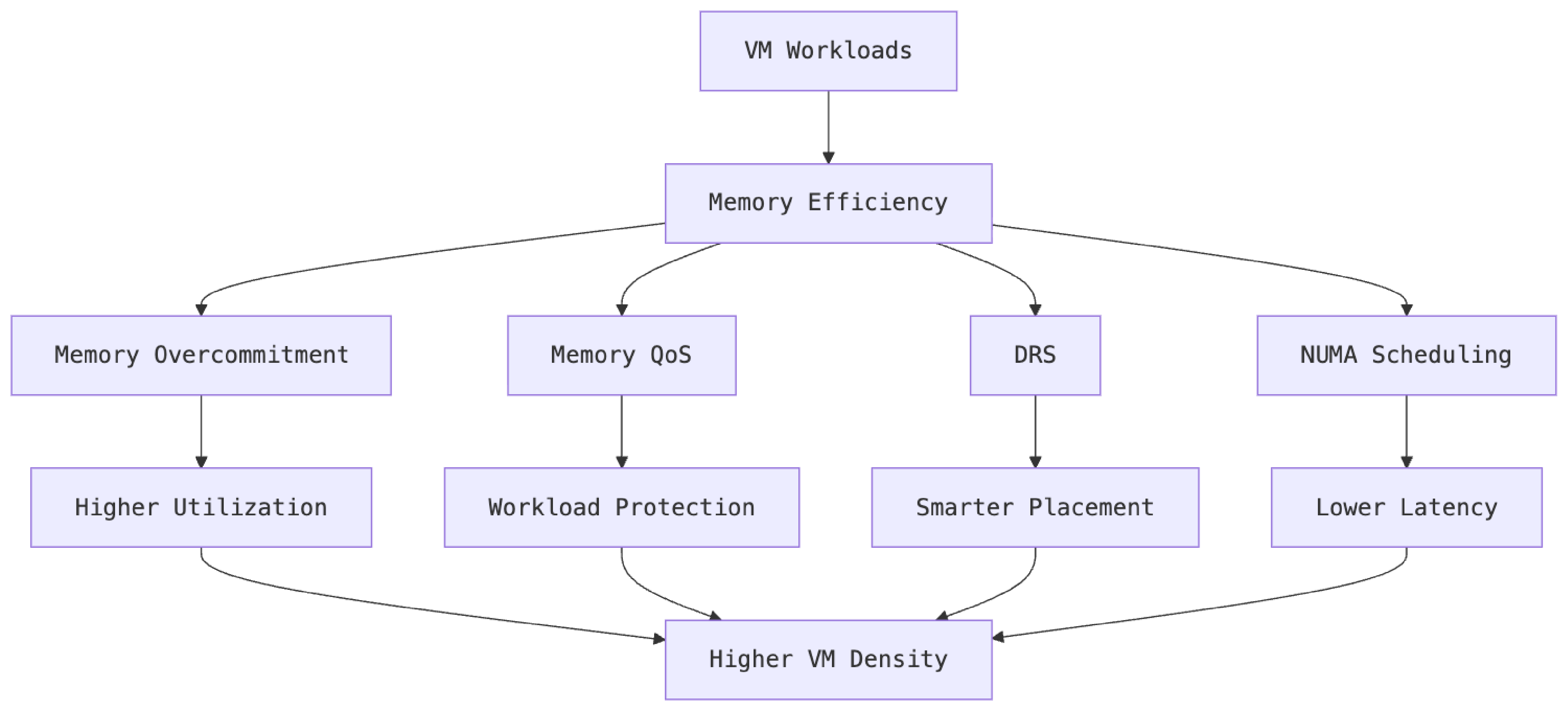
Arcfra’s memory efficiency approach combines workload placement, full-stack resource optimization, and planned 2026H2 capabilities such as memory overcommitment, Memory QoS, and NUMA-aware scheduling.
Arcfra focuses on the broader customer challenge regarding memory efficiency in virtualized environments: how to improve memory utilization and VM density in a controlled, stable, and operationally manageable way.
In the Arcfra Enterprise Cloud Platform, memory efficiency is not an isolated feature. It is part of a broader set of resource optimization capabilities across the virtualization layer.
Through memory overcommitment, Arcfra helps enterprises use physical memory more efficiently in virtualized environments. The platform can allocate more virtual memory to VMs than the physical memory available on a host, reducing the inefficiency caused by static reservation.
The logic is straightforward: assigned memory is not always active memory. Peak demand is not always sustained demand. Many enterprise workloads leave usable gaps between allocated resources and actual runtime usage. Memory overcommitment allows the platform to manage those gaps and improve overall workload density.
Memory overcommitment without boundaries can create risk. That is why Arcfra combines memory efficiency with workload placement and planned capabilities such as Memory QoS and NUMA-aware scheduling, helping enterprises improve utilization while maintaining stronger control over resource pressure.
As these capabilities mature, Memory QoS will help protect critical workloads under resource pressure. DRS enables the platform to consider CPU, memory, and storage conditions when placing and balancing workloads. NUMA-aware scheduling will help reduce cross-NUMA memory access and improve workload performance by keeping CPU and memory placement aligned.
The goal is not simply to “use more memory.” The goal is predictable high utilization. Enterprises need higher density, but they also need performance isolation, operational visibility, and clear control when resource pressure occurs.
Beyond Memory: Full-Stack Resource Efficiency
Memory efficiency is only one part of infrastructure efficiency. Arcfra’s value lies in turning resource efficiency into a full-stack enterprise cloud capability, not a single-point mechanism.
At the virtualization layer, workload scheduling and planned memory efficiency capabilities help improve VM utilization, workload density, and resource control.
At the compute layer, NUMA affinity and CPU-memory coordination help align resource placement with real workload behavior.
At the storage layer, Arcfra provides high-performance distributed block storage, RDMA, Boost mode, Intel DSA, and io_uring-based optimization to support low-latency, high-throughput enterprise workloads. Storage performance is not an isolated metric. It affects VM density, database performance, application response time, and the responsiveness of data-intensive and agentic AI applications.
In agentic AI scenarios, resource efficiency extends beyond memory alone. Multi-turn interactions, concurrent agent workflows, vector databases, persistent context, and long-running application sessions place pressure across memory, storage, networking, compute, Kubernetes, databases, and operations. Arcfra’s full-stack software-defined infrastructure helps enterprises address these mixed workload requirements through coordinated resource optimization and unified operational management.
At the operations layer, unified management, monitoring, scheduling, and lifecycle management make these capabilities usable in production. Enterprise infrastructure cannot rely on isolated optimizations that are hard to manage. Arcfra Enterprise Cloud Platform brings virtualization, storage, Kubernetes, networking, security, backup, disaster recovery, and operations into one software-defined infrastructure platform.
This is how resource efficiency becomes operational.
Memory Efficiency as a Key Metric for Agentic AI Infrastructure
As the Linux kernel, hypervisor, and hardware ecosystems continue to evolve, capabilities such as memory expansion, memory tiering, overcommitment, QoS, and resource scheduling will continue to mature. For Arcfra, the priority is to turn these technologies into practical, observable, and manageable infrastructure efficiency for enterprise virtualization and cloud environments.
For enterprise customers, the real question is not whether infrastructure has more resources, but whether it can use those resources more efficiently under real production constraints. As agentic AI becomes part of enterprise application environments, infrastructure must support higher workload density, stronger resource coordination, and more predictable operations.
Agentic AI infrastructure is not only about faster CPUs, larger DRAM capacity, more GPUs, or more NVMe drives. It also requires better ways to coordinate and utilize existing resources. Sustainable enterprise infrastructure must balance performance, capacity, cost, and operational predictability.
Arcfra’s inclusion as a Gartner Sample Vendor in Hype Cycle for Compute, 2026 underscores the relevance of this direction: practical infrastructure efficiency is becoming central to enterprise modernization.
The next stage of enterprise infrastructure will not be defined only by who can add more resources. It will be defined by who can use them better.
Memory overcommitment, Memory QoS, and NUMA-aware scheduling are planned capabilities in upcoming releases of 2026H2.
GARTNER is a registered trademark and service mark, and HYPE CYCLE is a registered trademark of Gartner, Inc. and/or its affiliates in the U.S. and internationally and are used herein with permission. All rights reserved. Gartner does not endorse any vendor, product, or service depicted in its research publications.
Arcfra simplifies enterprise cloud infrastructure with a full-stack, software-defined platform built for the AI era. We deliver computing, storage, networking, security, Kubernetes, and more — all in one streamlined solution. Supporting VMs, containers, and AI workloads, Arcfra offers future-proof infrastructure trusted by enterprises across e-commerce, finance, and manufacturing. Arcfra is recognized by Gartner as a Representative Vendor in full-stack hyperconverged infrastructure. Learn more at www.arcfra.com.